Spectre Brands

DeadVideo game console · Tokyo and San Francisco

Sega Dreamcast

Launched in Japan Nov 27, 1998 and in North America Sep 9, 1999. Cancelled Jan 31, 2001.

The slogan was “It’s thinking.” By the time the PlayStation 2 arrived, so were its customers.

Why dead: Sega decided on January 31, 2001 to stop making the Dreamcast and left the console hardware business; Sega itself survives as a software publisher inside Sega Sammy Holdings, so it is the console and Sega’s hardware line that died, not the company.225

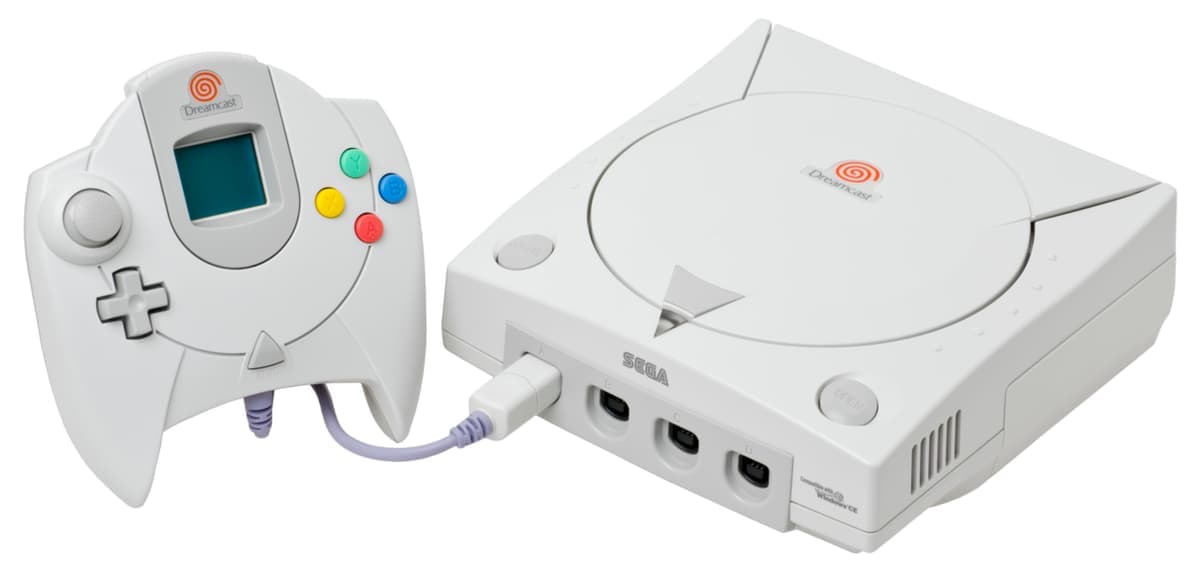
White Dreamcast console with its controller
The console and controllerPhoto: Evan-Amos, via Wikimedia Commons, CC BY-SA 3.0.
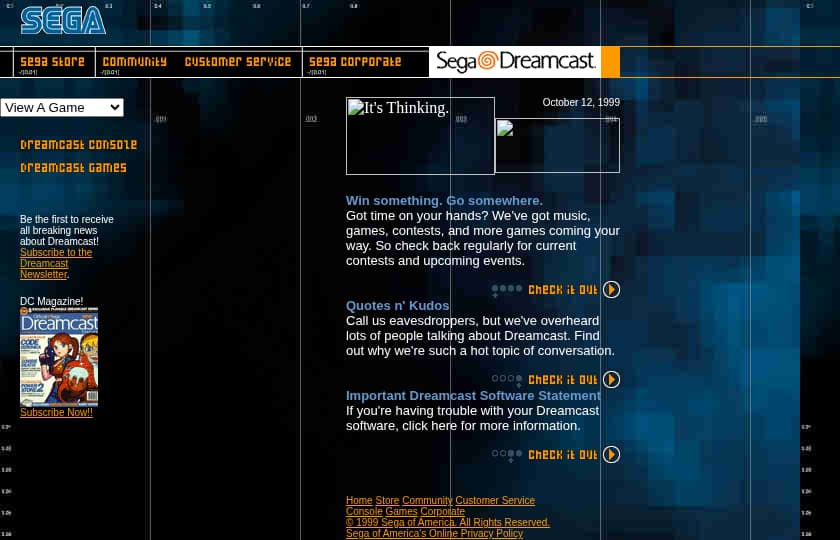
sega.com home page in October 1999 with the It’s Thinking tagline
sega.com, Oct 1999Cropped from an Internet Archive capture of sega.com. Shown for commentary; trademarks belong to their owners.
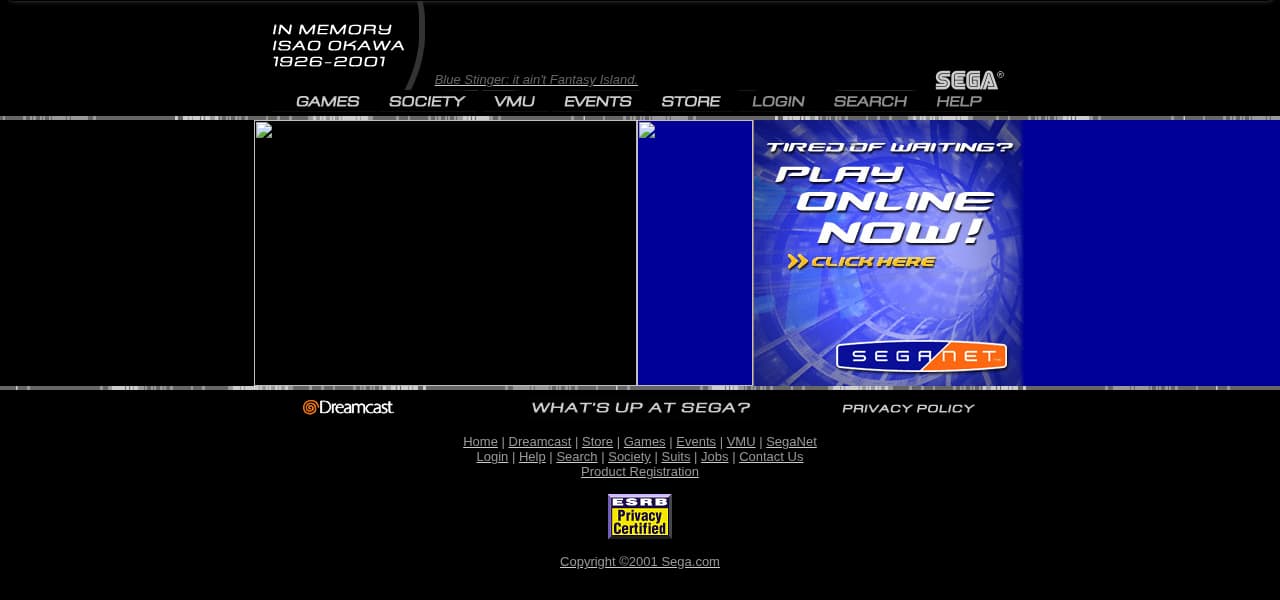
sega.com home page in April 2001 with a memorial notice for Isao Okawa
sega.com, Apr 2001

Sega’s last console came with a modem, a record first day and the best sports games of its generation. It also came from a company that lost money in every year of the console’s life, had lost Electronic Arts, and was selling into the shadow of a rival that was not yet on shelves. This post-mortem is built from Sega’s annual reports, wire and trade coverage from 1999 to 2001, later interviews with the people who ran it, and the archived sega.com.

The console in four numbers

$98.4M
U.S. sales in the first 24 hours, as Sega reported it, on 225,132 consoles718
8.20M
consoles sold worldwide by March 31, 2001, by Sega’s own count2
¥52.4B
written off on unsold inventory, mostly Dreamcast hardware, in fiscal 20012
510 days
from the North American launch to the exit announcement (derived)27

Key findings

  1. The launch worked. The second Christmas did not. Sega sold 4.65 million consoles in the year to March 2000 and 3.39 million in the next, which its annual report said “fell far short of targets.”12
  2. It lost to a console that was barely in stores. The Associated Press reported on the day of the exit that U.S. game fans had given up on the machine in favour of the PlayStation 2, which had then sold about 6.4 million units worldwide.4
  3. Sega could not afford a long fight. The company lost money in each of the three fiscal years to March 2000, and another ¥51.7 billion in the year it quit.12
  4. The biggest sports publisher stayed away. Electronic Arts never released a Dreamcast game. Sega built the 2K sports line instead and sold it to Take-Two for about $24 million in 2005.726
  5. One man’s shares softened the landing. Chairman Isao Okawa gave Sega assets that produced a ¥77.9 billion gain, more than the ¥52.4 billion inventory write-off.2

The story

A record first day, and a rival that was not yet on the shelf

The Dreamcast did not fail at launch. It failed in its second holiday season, when Sega needed it to pay for itself and buyers were waiting for a Sony machine most of them could not yet find.

Chapter 1 of 5

¥35.6B

Sega’s net loss in the year to March 1998, before the Dreamcast existed

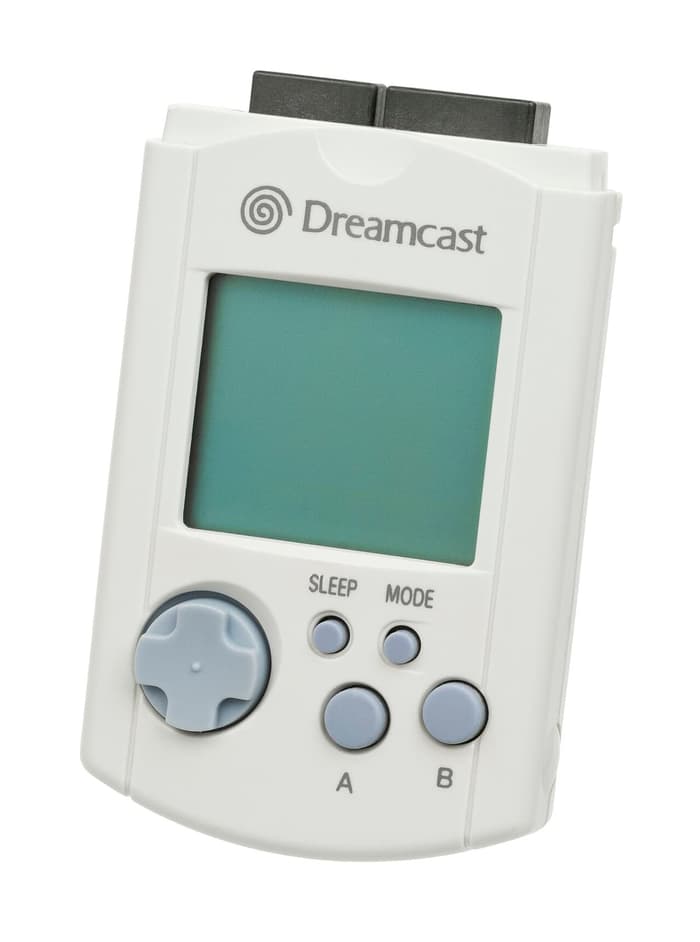
The controller had a slot for a memory card with its own small screen. Original illustration.

1996 – 1998 · After the Saturn

A company that needed a clean start

Sega came to its last console already hurt. “Saturn, as you know, was a failure,” Bernie Stolar, who ran Sega of America from 1996, said later. He cut the U.S. company from more than 300 people to about 90 and spent 1998 persuading retailers to trust Sega again.721

The parent was losing money: ¥35.6 billion in fiscal 1998 and ¥42.9 billion in fiscal 1999.1 In Tokyo two hardware teams competed for the design. The Japanese one won, built on a Hitachi SH4 processor and an NEC-made PowerVR graphics chip.7 The machine went on sale in Japan on November 27, 1998 at ¥29,800.184 IGN’s history calls the Japanese launch “unspectacular” and held back by a shortage of NEC chipsets.20

Chapter 2 of 5

300,000

U.S. pre-orders before launch day, a record at the time

Commercial · 1999“Apocalypse,” the 9/9/99 launch commercial The big-budget spot by Foote, Cone & Belding, filmed in Vancouver. Peter Moore says it ran once, on launch night during the MTV Video Music Awards.6 This copy is a fan restoration uploaded in 2025. Watch on YouTube

Spring – Summer 1999 · “It’s thinking”

Seven months to build a launch

Peter Moore, hired from Reebok in early 1999, had months to build a campaign. “In 60 days we came up with ‘It’s Thinking’,” he told the Guardian. A large-budget spot filmed in Vancouver ran once, on launch night, during the MTV Video Music Awards.6

Two things went wrong before launch. Electronic Arts, the biggest sports publisher, declined to support the machine; Stolar says EA wanted to be the only sports brand on the platform and he refused because Sega had bought the studio Visual Concepts for $10 million.7 And on August 4, five weeks before launch, Sega of America announced that Stolar was out, effective August 11.16 Retailers still took a record 300,000 pre-orders.7

Chapter 3 of 5

$98.4M

reported U.S. retail sales in the first 24 hours

News segment · 1999KATU News: the Dreamcast launch Local television coverage from Portland, Oregon. The station says it originally aired on September 9, 1999. Watch on YouTube

Sep 9, 1999 · 9/9/99

The biggest day in the business

The console launched in North America at $199 with 18 games, at more than 15,000 stores.716 Sega said it sold 225,132 consoles in the first 24 hours and took in $98.4 million across hardware, games and accessories, and 514,000 consoles within two weeks.717

The year to March 2000 was the peak. Sega sold 4.65 million consoles, consumer sales more than doubled to ¥186.2 billion and 1.12 million owners had registered online.1 The same report shows the cost: an operating loss of ¥43.0 billion in the consumer division, and a Japanese market where results “fell well below target figures.”1

Chapter 4 of 5

$149

U.S. price from August 31, 2000, with a $150 rebate for SegaNet subscribers

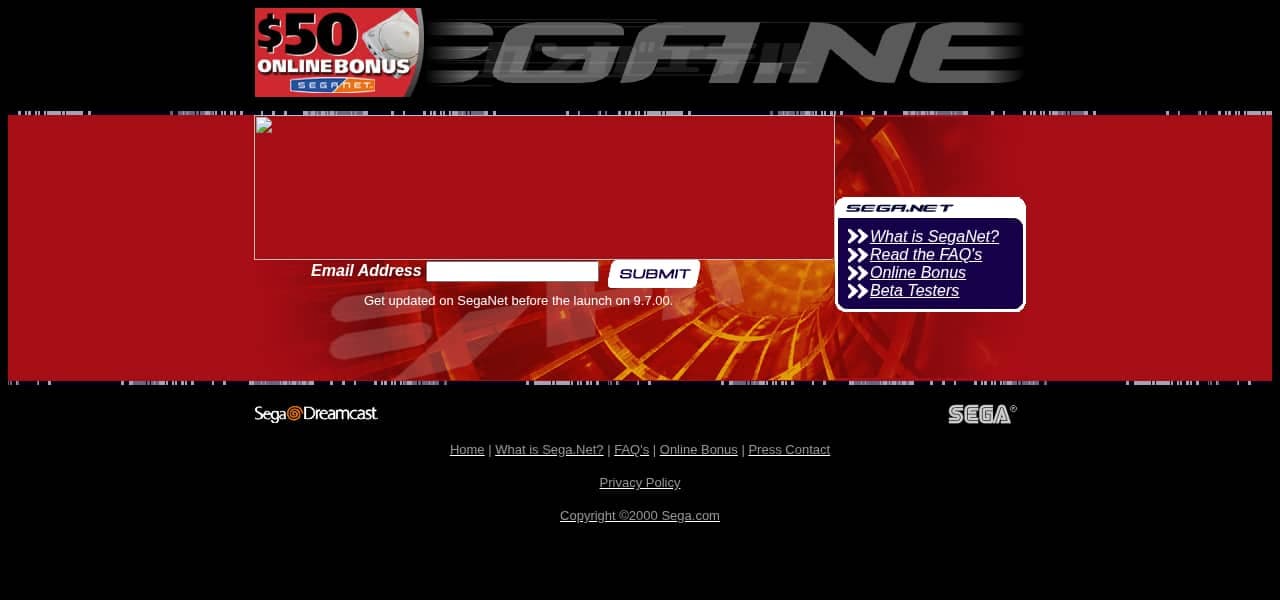
SegaNet teaser page from August 2000 with a $50 online bonus badge
sega.net in August 2000: “Get updated on SegaNet before the launch on 9.7.00.”27

2000 · The modem and the wait

Online first, and a rival already in every headline

Every Dreamcast had a modem. On August 31, 2000 Sega cut the U.S. price to $149 and offered a $150 rebate to anyone who signed up for 18 months of its new online service, SegaNet, at $21.95 a month. The service opened on September 7.1514 Weekly U.S. sales rose 156.5% between late July and the end of September, according to PC Data.14

It was not enough. Pirates had worked out in mid-2000 how to run copied games from ordinary CDs.19 The PlayStation 2 reached U.S. stores on October 26 with EA’s games and a DVD player.720 In September, Moore and Charles Bellfield had already told Tokyo that Sega of America was “not viable as a hardware player in the States beyond Christmas 2000.”7

Chapter 5 of 5

2 million

unsold consoles Sega was holding worldwide on the day it quit

News segment · 2001AP: “Japan: Sega announces future of Dreamcast” Associated Press footage of the Tokyo news conference on January 31, 2001, where vice president Hideki Sato announced the end of production.4 Watch on YouTube

Jan 31, 2001 · The exit

“Sega is leaving hardware”

Between April and December 2000 Sega sold 2.3 million consoles worldwide.45 On January 23 the Nikkei reported that production would end; Sega of America said the company “remains committed to the Dreamcast format.”13 Eight days later the board made it official. Production would stop by the end of March, the U.S. price fell to $99 to clear about 2 million machines, and Sega would make games for Sony, Nintendo and Microsoft.45

Isao Okawa, the chairman and president, gave the company his own shares and other assets; he died on March 16.2 Sega wrote off ¥52.4 billion of inventory and lost ¥51.7 billion for the year. A year later it reported its first operating profit in three years.23

Sega had the option of pouring in more money and going bankrupt and they decided they wanted to live to fight another day.

Peter Moore, to the Guardian, 20086

Timeline

From the Saturn to Sega Sammy, in 27 moments

The console’s life, the money behind it and the rivals around it. Filter by thread.

All 28 events as a list
  1. Jul 19961996
    Corporate

    Bernie Stolar takes over Sega of America

    The former Sony executive becomes president and cuts the U.S. company from more than 300 people to about 90.721

  2. Sep 7, 19971997
    Product

    Sega confirms a new console, code-named Katana

    The Japanese design, with a Hitachi SH4 processor and an NEC-made PowerVR chip, beats a U.S. design built around a 3Dfx chip.7

  3. Mar 311998
    Money

    A ¥35.6 billion loss

    Sega Enterprises reports a net loss of ¥35,635 million for fiscal 1998.1

  4. Nov 27
    Product

    Launch in Japan

    The Dreamcast goes on sale at ¥29,800. Supply is limited by a shortage of NEC chipsets.18420

  5. Early 19991999
    Corporate

    Peter Moore joins from Reebok

    He is hired to run marketing for the U.S. launch and builds the “It’s Thinking” campaign with the agency Foote, Cone & Belding.67

  6. Mar 31
    Money

    A ¥42.9 billion loss

    Net loss of ¥42,881 million for fiscal 1999. Consumer product sales fall to ¥84.7 billion.1

  7. 1999
    Rivals

    Electronic Arts stays out

    Talks between Stolar and EA’s Larry Probst end without a deal. EA never publishes a Dreamcast game.76

  8. Aug 4
    Corporate

    Stolar is replaced

    Sega of America names Toshiro Kezuka chief operating officer and says Stolar is gone effective August 11, five weeks before launch.16

  9. Sep 9
    Product

    9/9/99: launch in North America

    $199, 18 games, more than 15,000 stores. Sega reports 225,132 consoles and $98.4 million in 24 hours.71618

  10. Sep 23
    Product

    Half a million in two weeks

    Sega says 514,000 consoles have been sold in the United States.177

  11. Oct 1999
    Product

    Launch in Europe

    Sega’s annual report dates the European launch to October 1999.1

  12. Nov 1999
    Corporate

    Okawa says it may be the last console

    The Register later recalled that chairman Isao Okawa said in November 1999 that the Dreamcast would be Sega’s last console.12

  13. Mar 312000
    Money

    Peak year, and a third straight loss

    4.65 million consoles sold in the fiscal year, 5.55 million in all. Net loss ¥42,880 million.1

  14. Spring 2000
    Rivals

    PlayStation 2 launches in Japan

    Sony’s console arrives in Japan first; the U.S. launch follows in October.7

  15. May 2000
    Corporate

    Moore becomes president of Sega of America

    He holds the job until January 2003.21

  16. Jul 20
    Product

    Sega moves against pirates

    After the group Utopia shows that copied games can run from ordinary CDs, Sega says it has shut more than 60 websites and 125 auctions.19

  17. Aug 31
    Money

    Price cut to $149

    With a $150 rebate for buyers who take SegaNet for 18 months at $21.95 a month.15

  18. Sep 7
    Product

    SegaNet goes live

    Sega’s U.S. internet service and online gaming network opens.1427

  19. Sep 2000
    Corporate

    The “Manifesto of the Future”

    Moore and Charles Bellfield tell Sega’s executives and studio heads in Japan that the U.S. company cannot stay in hardware past Christmas.7

  20. Oct 26
    Rivals

    PlayStation 2 launches in North America

    At $299, with EA’s games and DVD playback.7520

  21. Jan 232001
    Exit & after

    The Nikkei breaks the story

    The paper reports that production will end on March 31. Sega of America says it “remains committed to the Dreamcast format.”13

  22. Jan 31
    Exit & after

    Sega leaves the console business

    The board decides to stop production. The U.S. price drops to $99 to clear about 2 million consoles, and Okawa’s donation of his assets is accepted.245

  23. Mar 16
    Corporate

    Isao Okawa dies

    The chairman and president dies aged 74.211

  24. Mar 31
    Money

    The bill

    Fiscal 2001 closes with a ¥52.4 billion inventory write-off and a net loss of ¥51.7 billion.2

  25. Sep 14
    Rivals

    GameCube launches in Japan

    Nintendo’s console arrives; Microsoft’s Xbox follows later in the year. Sega makes games for both.233

  26. Mar 312002
    Money

    First operating profit in three years

    Operating income of ¥14.2 billion on sales of ¥206.3 billion. Sega sells 7.07 million games for other companies’ consoles.3

  27. Oct 20042004
    Exit & after

    Sega Sammy Holdings

    Sega Corporation and Sammy Corporation combine under a holding company.25

  28. Jan 252005
    Exit & after

    The 2K studio is sold

    Take-Two buys Visual Concepts and Kush Games from Sega for about $24 million in cash, with the 2K brand.26

Part 2 of 6

Business

The numbers · Marketing · Rivals

The money

One good year in five

Sega published its results in yen for fiscal years ending March 31. The Dreamcast gave the consumer division one year of growth. It never gave it a profit.

Sega’s consumer product sales, fiscal 1998 to 2002

Billions of yen, years ending March 31. This is the division that sold consoles and games.

¥0.0B¥50.0B¥100.0B¥150.0B¥200.0BFY1998FY1999FY2000FY2001FY200212345¥0.0B¥100.0B¥200.0BFY1998FY1999FY2000FY2001FY200212345
  1. FY1998 · The Saturn fades Consumer sales of ¥114.5 billion and a company-wide net loss of ¥35.6 billion.1
  2. FY1999 · Launch in Japan The Dreamcast goes on sale in November 1998. Consumer sales still fall to ¥84.7 billion.1
  3. FY2000 · Launch in the U.S. and Europe 4.65 million consoles sold in the year. Sales rise 119.8% to ¥186.2 billion, with a ¥43.0 billion operating loss.1
  4. FY2001 · The second Christmas 3.39 million consoles. Sales fall 37.8% and the division’s operating loss reaches ¥69.2 billion.2
  5. FY2002 · After the exit Final hardware and accessory sales of ¥11.1 billion. Sega is now a publisher on other companies’ consoles.3
Data table
Sega’s consumer product sales, fiscal 1998 to 2002
Fiscal year ending March 31Consumer product sales
FY1998¥114.5B
FY1999¥84.7B
FY2000¥186.2B
FY2001¥115.8B
FY2002¥85.1B
Sega Enterprises annual report 20001, Sega Corporation annual reports 2001 and 200223. The fiscal 2002 figure is the renamed “Consumer business” segment.

Net sales and net loss, whole company

Billions of yen. Sega lost money in all five years.

Data table
Net sales and net loss, whole company
PeriodNet salesNet loss
FY1998¥331.6B¥-35.6B
FY1999¥266.2B¥-42.9B
FY2000¥339.1B¥-42.9B
FY2001¥242.9B¥-51.7B
FY2002¥206.3B¥-17.8B
Consolidated statements in the annual reports for 2000, 2001 and 2002123. Figures rounded from millions of yen.

Consoles sold, by fiscal year

Millions of Dreamcast units, worldwide, as Sega reported them.

Data table
Consoles sold, by fiscal year
PeriodConsoles sold
FY19990.90M
FY20004.65M
FY20013.39M
FY2000: 4.65 million in the year, “5.55 million overall”1. FY1999 (0.90 million) is derived: 5.55 − 4.65. FY2001: 3.39 million2. The same report gives a cumulative total of 8.20 million, which is 0.74 million less than these three bars add up to; Sega did not explain the difference.

Where the last full year’s consoles went

Share of the 3.39 million consoles sold in fiscal 2001.

  1. 52.5%United States1.78 million
  2. 27.4%Europe930,000
  3. 13.9%Japan470,000
  4. 6.2%Asia outside Japan210,000
Data table
Where the last full year’s consoles went
RegionShare
United States52.5%
Europe27.4%
Japan13.9%
Asia outside Japan6.2%
Unit sales by region from the annual report 20012. Percentages are derived from those units.

The second Christmas, in Sega’s own numbers

2.3M
consoles sold worldwide from April to December 2000, against 4.65 million in the whole previous fiscal year451
¥69.2B
operating loss in consumer products in fiscal 2001, up from ¥43.0 billion2
¥52.4B
loss on writing down or disposing of inventory, “primarily Dreamcast hardware and peripherals”2
¥37.6B
cash left at March 31, 2001, down ¥60.7 billion in a year2
Sega Corporation annual report 20012; AP and ABC News, January 31, 200145.

What Isao Okawa handed over

Assets the chairman donated to Sega in January 2001, as itemised in the notes to the accounts. Billions of yen.

¥108.6B total donated assets
¥57.5B 53%Investments in securities¥33.6B 31%Sega’s own shares¥9.1B 8%Other current assets¥7.1B 7%Other investments¥1.2B 1%Long-term loans receivable¥57.5B 53%Investments in securities¥33.6B 31%Sega’s own shares¥9.1B 8%Other current assets¥7.1B 7%Other investments¥1.2B 1%Long-term loans receivable
  • Investments in securities. Shares in other companies. Press reports named CSK, Ascii and NextCom.11
  • Sega’s own shares. 19,865,718 shares, booked as treasury stock.2
Data table
What Isao Okawa handed over
Where it wentAmountShareNote
Investments in securities¥57.5B53%Shares in other companies. Press reports named CSK, Ascii and NextCom.
Sega’s own shares¥33.6B31%19,865,718 shares, booked as treasury stock.
Other current assets¥9.1B8%
Other investments¥7.1B7%
Long-term loans receivable¥1.2B1%
Note 22 to the consolidated accounts, annual report 20012. Sega also took on ¥30.7 billion of liabilities with the gift and booked a net gain of ¥77.9 billion ($628.8 million at the report’s rate). The press put the gift at ¥85 billion, or about $695 million11; an earlier report said $566.3 million10. In fiscal 2002 Sega booked a ¥16.7 billion “loss on settlement of donated assets.”3

How many Dreamcasts were sold in total is not settled. Sega’s 2001 annual report says 8.20 million by March 31, 2001.2 Adding its own yearly figures gives 8.94 million (derived).12 Sales continued from inventory after that date and Sega did not publish a final unit count in its 2002 report.3 Figures of 9.13 million and 10.6 million are widely repeated; we could not trace either to a primary document and treat them as unverified.

Marketing

A date, a tagline and a tour bus

Sega of America had little money and seven months. It built the launch around a date people could remember and a campaign that explained almost nothing.

“It’s thinking”

Moore’s brief was to “somewhat apologize for the past” while recalling what people liked about Sega in the Genesis years. The answer was a run of 15-second spots that never quite said what the machine was. “It was mysterious,” he said. “First of all, if you didn’t know, maybe we didn’t want to talk to you.”7

The launch itself was staged as an event: 9/9/99 for $199, a spot on the MTV Video Music Awards, and sponsorship of rock tours.6 A second series, “In the Box,” put NFL and NBA players alongside characters from the games.7

Commercial · 1999The “It’s Thinking” commercials, 1999–2000 A six-minute reel of the short spots that introduced the console in the United States. The years are the uploader’s. Watch on YouTube

The launch in Sega’s numbers

300,000
U.S. pre-orders before launch7
225,132
consoles sold in the first 24 hours718
372,000
consoles in the first four days, worth $132 million with games and accessories7
514,000
consoles in two weeks; the original PlayStation took over four months to reach half a million in the United States177
Sega announcements as reported by Gamasutra, RPGamer and Time Extension71718. These are company figures and were not independently audited.

We were a big brand. But then it all went pear-shaped in Christmas 2000.

Peter Moore, to the Guardian, 20086
56K
Original illustration.

The feature the ads undersold

Every console shipped with a modem, and by March 2000 Sega counted 1.12 million registered network users: 550,000 in Japan, 330,000 in the United States and 240,000 in Europe.1 Sega’s own U.S. online service, SegaNet, opened a year after launch.14

The price, cut by cut

DateUnited StatesWhy
Sep 9, 1999$199Launch price7
Aug 31, 2000$149With a $150 rebate for an 18-month SegaNet contract15
Jan 31, 2001$99To clear about 2 million unsold consoles54
In Japan the price fell from ¥29,800 at launch to ¥19,900.4

The rivals

Four consoles, one runaway winner

The Dreamcast opened the sixth generation of consoles and was the only one of the four to be cancelled inside three years. The other three makers are all still in the business.

Lifetime console sales, sixth generation

Millions of units, each maker’s own figure.

PlayStation 2 (Sony)
160M+
“More than 160 million,” as of March 2012.22
Xbox (Microsoft)
24M+
“More than 24 million,” May 2006.24
GameCube (Nintendo)
21.74M
Life to date.23
Dreamcast (Sega)
8.20M
To March 31, 2001, Sega’s count. Later totals of 9.13 to 10.6 million are unverified.2
Data table
Lifetime console sales, sixth generation
ConsoleUnits soldNote
PlayStation 2 (Sony)160M+“More than 160 million,” as of March 2012.
Xbox (Microsoft)24M+“More than 24 million,” May 2006.
GameCube (Nintendo)21.74MLife to date.
Dreamcast (Sega)8.20MTo March 31, 2001, Sega’s count. Later totals of 9.13 to 10.6 million are unverified.
Sony Interactive Entertainment22, Microsoft24, Nintendo23 and Sega’s annual report 20012. The Sony and Microsoft figures are lower bounds. The Dreamcast figure excludes clearance sales after March 2001, so it understates the final total by an unknown amount.

Who won, who quit

Each console’s lifetime sales and what became of its maker’s hardware business.

Dreamcast

Cancelled 2001
FY1999FY2001
8.20M Sega’s count to March 2001.2 Sega left hardware and became a publisher.

PlayStation 2

Won
160M+ The best-selling of the four by a wide margin.22 It reached the United States on October 26, 2000.7

GameCube

Maker still in consoles
FY2002FY2008
21.74M Released in Japan on September 14, 2001.23 Sega sold 1.22 million games for it in its first year as a publisher.3

Xbox

Maker still in consoles
24M+ Microsoft’s first console.24 Sega’s U.S. team expected Microsoft’s entry as early as September 2000.7
Data table
Who won, who quit
CompanyOutcomeLifetime unitsNotesSeries
DreamcastCancelled 20018.20MSega’s count to March 2001. Sega left hardware and became a publisher.0.9, 4.65, 3.39
PlayStation 2Won160M+The best-selling of the four by a wide margin. It reached the United States on October 26, 2000.
GameCubeMaker still in consoles21.74MReleased in Japan on September 14, 2001. Sega sold 1.22 million games for it in its first year as a publisher.380, 576, 502, 392, 235, 73, 16
XboxMaker still in consoles24M+Microsoft’s first console. Sega’s U.S. team expected Microsoft’s entry as early as September 2000.
As for the chart above. Sparklines: Dreamcast units by fiscal year in millions12; GameCube units by Nintendo fiscal year in ten-thousands23.

For every Dreamcast, about twenty PlayStation 2s

160M+PlayStation 2 consoles sold22
=
20 ×Dreamcast consoles sold by March 20012 (8.20M; each icon is 8.20 million consoles)

Derived 160 million ÷ 8.20 million = 19.5, rounded up to 20 icons. Each icon stands for one Dreamcast’s worth of PlayStation 2 sales.

Data table
For every Dreamcast, about twenty PlayStation 2s
Value
PlayStation 2 consoles sold160M+
Dreamcast consoles sold by March 20018.20M
Ratio20 (derived)
Sony Interactive Entertainment22; Sega annual report 20012.

U.S. console market share, January to September 2000

Share of the retail and mail-order channel before the PlayStation 2 arrived, according to PC Data.

Data table
U.S. console market share, January to September 2000
PeriodShare since January 2000
PlayStation (Sony)47%
Nintendo 6436.4%
Dreamcast16.4%
PC Data figures as reported by the Register, October 9, 200014. In the weeks after the August price cut the Dreamcast’s share rose to just under 30%.
Cancelled

Dreamcast

U.S. launch
Sep 9, 1999, $1997
Disc
GD-ROM, Sega’s own format21
Plays DVD movies
No21
Online
Modem in the box1
EA games
None7
Units
8.20M to Mar 20012
Won

PlayStation 2

U.S. launch
Oct 26, 2000, $29975
Disc
DVD20
Plays DVD movies
Yes20
Online
Not at launch15
EA games
Yes7
Units
More than 160M22

Part 3 of 6

Brand

Commercials & footage · Old website · Brand gallery

Commercials & footage

It’s thinking

The launch campaign as it aired, local news from launch night, the wire footage of the day Sega quit, and a later look back.

Commercial · 1999“Apocalypse,” the 9/9/99 launch commercial The big-budget spot by Foote, Cone & Belding, filmed in Vancouver. Peter Moore says it ran once, on launch night during the MTV Video Music Awards.6 This copy is a fan restoration uploaded in 2025. Watch on YouTube
Commercial · 1999The “It’s Thinking” commercials, 1999–2000 A six-minute reel of the short spots that introduced the console in the United States. The years are the uploader’s. Watch on YouTube
News segment · 1999KATU News: the Dreamcast launch Local television coverage from Portland, Oregon. The station says it originally aired on September 9, 1999. Watch on YouTube
Commercial · 2000SegaNet commercial A spot for Sega’s online service. The uploader dates it 1999; SegaNet opened on September 7, 2000,14 so we list it under 2000. Watch on YouTube
News segment · 2001AP: “Japan: Sega announces future of Dreamcast” Associated Press footage of the Tokyo news conference on January 31, 2001, where vice president Hideki Sato announced the end of production.4 Watch on YouTube
Retrospective · 2015IGN: “The Rise and Fall of the Sega Dreamcast” A five-minute retrospective published in 2015. Its figures are IGN’s; ours are in the sections above. Watch on YouTube

Videos are embedded from the services that host them and load only when you press play. YouTube embeds use youtube-nocookie.com. Each video belongs to its uploader or rights holder and is shown here for commentary; we do not host any of the files.

The old website

sega.com, from “It’s Thinking” to “In memory”

Screenshots of pages saved by the Internet Archive’s Wayback Machine, stored as images. Click one to open the original capture. dreamcast.com itself was archived in this period, but its images were not saved, so these are from sega.com and sega.net.27

Screenshot of http://sega.com/ as archived Oct 12, 1999

Captured Oct 12, 1999

A month after launch

The U.S. home page five weeks after 9/9/99, with the “It’s Thinking” tagline, a game picker and links to the console and the store. The Flash banner at the left is missing.

Open this capture on the Wayback Machine

Text preserved in the archived pages

A “View A Game” menu listing the launch-window catalogue: NFL 2K, Sonic Adventure, Soul Calibur, Power Stone, Hydro Thunder, Ready 2 Rumble and more.
sega.com · Oct 12, 199927
“$50 online bonus” and “Get yourself connected.”
sega.com · Aug 15, 200027
“Get updated on SegaNet before the launch on 9.7.00.”
sega.net · Aug 17, 200027
“In memory Isao Okawa 1926–2001” above “Tired of waiting? Play online now!”
sega.com · Apr 9, 200127

Flash elements in these pages no longer run and were removed before the screenshots were taken; some banner images were never archived and show as empty boxes.

Part 4 of 6

People

People · Press

The people

Who ran it

Roles are as described in the sources cited. Later careers are included only where we found a source.

People (8)
Name and roleWhat they didAfterwards
Isao OkawaChairman and president, Sega

Founder of the CSK Group and Sega’s main backer. In January 2001 he gave the company his Sega shares and other assets, producing a ¥77.9 billion gain.2

Died March 16, 2001, aged 74.211
Shoichiro IrimajiriPresident, Sega, during development

Set two hardware teams against each other in 1997: Hideki Sato’s in Japan and an outside group in the United States.7

Hideki SatoHardware chief; later vice president

Designed the Saturn and led the winning Dreamcast design. He announced the end of production at the Tokyo news conference on January 31, 2001.74

Bernie StolarPresident, Sega of America, 1996 – Aug 1999

Rebuilt the U.S. company and its retail relationships, bought Visual Concepts and refused EA’s terms. Replaced five weeks before launch.716

Peter MooreMarketing chief, then president, Sega of America

Joined from Reebok in early 1999, ran the 9/9/99 launch and became president in May 2000.621 He delivered the exit announcement in the United States.9

Joined Microsoft in 2003 and Electronic Arts in 2007.89
Charles BellfieldVP communications, later strategy, Sega of America

Co-wrote the September 2000 paper advising Tokyo to leave hardware. His verdict: “Money. Money talks. You need a budget.”7

Toshiro KezukaVice-chairman and COO, Sega of America, from Aug 1999

Named to the top U.S. post on August 4, 1999 in place of Stolar.16

Bing GordonChief creative officer, Electronic Arts

The EA executive quoted as saying the Dreamcast could not succeed without EA. He later said Sega “was not acting like a competent hardware company.”7

The clippings

What they said

Press (9)
It’s game over for the Sega Dreamcast.
ABC News, January 31, 20015
Dreamcast was a phenomenal 18 months of pain, heartache, euphoria…
Peter Moore, to the Guardian, 20086
  1. Hideki Sato, Sega vice president, as translated by the Associated Press, January 31, 20014

    We hereby announce our decision to stop production of Dreamcast as of the March term of 2001.
  2. Charles Bellfield, Sega of America, eight days before the exit, quoted by the Register13

    Sega remains committed to the Dreamcast format going forward.
  3. Peter Moore, July 200019

    Pirates are parasites that hurt this community and will not be tolerated by Sega.
  4. Peter Moore, on SegaNet, August 200015

    We are not going to hang around for three or four years to wait for broadband, but when it’s there, we’re ready to go.
  5. Peter Moore, to the Guardian, 20086

    I’ve never met anybody who regretted buying a Dreamcast.
  6. Charles Bellfield, to Gamasutra, 20097

    We had the content right. We had the marketing right. The product was designed right.
  7. Bernie Stolar, to Gamasutra, 20097

    Great content drives hardware.

Part 5 of 6

Verdict

Cause of death · What if · Afterlife

Cause of death

The autopsy

Tap a cause to see the evidence. The percentages are our editorial weighting. The evidence under each one is sourced.

Cause of death, by editorial weight

One square is one percentage point. The weights are our judgment, not a measurement.

  1. 35%The PlayStation 2, before and after it arrived
  2. 25%A parent that could not fund a long war
  3. 15%No Electronic Arts, and a trust deficit
  4. 15%The home market never came
  5. 10%Piracy and the disc format
Data table
Cause of death, by editorial weight
CauseWeight
The PlayStation 2, before and after it arrived35%
A parent that could not fund a long war25%
No Electronic Arts, and a trust deficit15%
The home market never came15%
Piracy and the disc format10%

Sony’s console reached U.S. stores on October 26, 2000 with DVD playback and EA’s games.720 Sega’s annual report says the Dreamcast “lost significant momentum during the all-important pre-Christmas sales season.”2 Moore’s account: sales were “just not going to be enough to get the critical mass to take on the launch of PS2.”6

Net losses of ¥35.6 billion, ¥42.9 billion and ¥42.9 billion in the three years to March 2000, then ¥51.7 billion.12 Bellfield said Sega announced $100 million of launch marketing and doubted it spent half; that is his recollection, not a reported figure.7 Moore recalled the console selling at $199 and costing “probably” $250 to $260 to make.9

EA published nothing for the machine. Bing Gordon and Bernie Stolar give different reasons, but agree on the result.7 Stolar also describes retailers who “really hated Sega” after the Saturn.7

Japan bought 950,000 consoles in fiscal 2000 and 470,000 in fiscal 2001, against 1.78 million in the United States that year.12 Sega’s report blamed “a maturing of the market” in Japan.1

From mid-2000 copied games could run from ordinary CDs with no modification to the console.1920 The proprietary GD-ROM also meant no DVD movies.21 How much revenue piracy cost is unknown.

Editorial judgment: the weights are an interpretive model by the Spectre Brands editors, not a measured quantity. Sega’s reports document the losses. How much each cause contributed is a matter of opinion.

The fork in the road

What if…

Three decisions where the story could have gone differently. The “What if” panels are speculation, labeled as such.

What happened

By Stolar’s account, EA’s Larry Probst asked for exclusive rights to sports games on the console. Stolar had just bought Visual Concepts for $10 million and refused: “Forget it then, end of story.”7 EA’s Bing Gordon was quoted saying “Dreamcast can’t succeed without EA.”7

What if speculative

With Madden and FIFA on the box, the machine would have had the best-known sports brands of the era, and one fewer reason to wait for a PlayStation 2. It would not have had NFL 2K, which, IGN wrote, many fans and critics preferred to Madden.20 Bellfield doubted any EA game would have changed the outcome.7

What happened

The console used Sega’s own GD-ROM discs. Stolar says Sega could not afford a DVD drive, and a promised add-on never appeared.21 The PlayStation 2 played DVD movies.20

What if speculative

A DVD drive would have removed one of Sony’s clearest advantages and closed the CD-R piracy hole. It would also have raised the cost of a machine that Moore recalls was already sold below cost,9 and delayed a launch whose whole point was to arrive first.

What happened

In September 2000 Moore and Bellfield advised Tokyo to get out of hardware. The studio heads walked out of the meeting.7 The decision came on January 31, 2001, after the holiday season, with about 2 million consoles unsold.4

What if speculative

An exit announced before Christmas would have saved some of the ¥52.4 billion inventory write-off,2 but it would have killed holiday sales of the console and its games. Sega’s first year as a publisher produced an operating profit,3 which suggests the destination was right even if the timing was forced.

Where are they now

The afterlife

Sega Dreamcast

  1. The console

    Discontinued

    Production stopped by the end of March 2001. Remaining stock was sold at $99 in the United States, and Sega booked ¥11.1 billion of final hardware and accessory sales in fiscal 2002.53

  2. Sega

    Survived

    In its first year without a console Sega sold 7.07 million games for other companies’ machines, 3.5 million of them on the PlayStation 2, and returned to operating profit.3 It is now part of Sega Sammy Holdings.25

  3. The 2K sports studio

    Sold

    Visual Concepts, bought for $10 million to replace EA’s sports games,7 went to Take-Two with the 2K brand for about $24 million in January 2005.26

  4. Peter Moore

    Moved on

    He joined Microsoft in 2003 to work on Xbox and moved to Electronic Arts in 2007.89

  5. Isao Okawa

    Died

    The chairman who gave Sega his shares died on March 16, 2001. In April 2001 the sega.com home page carried the line “In memory Isao Okawa 1926–2001.”227

  6. The idea

    Vindicated

    Moore said the Dreamcast “was the precursor to the next-gen consoles” because it went online first, even with SegaNet at “just 50,000 people.”6 Sega’s 2002 report says it “created the first online console gaming network with Dreamcast.”3

Who has owned the Dreamcast name

The brand never left Sega. The company around it changed.

  1. Nov 1998

    Sega Enterprises, Ltd.

    Launches the console in Japan, then in the United States and Europe in 1999.118

  2. Jan 2001

    Sega Corporation

    The renamed company decides to stop production and leave hardware.2

  3. 2001–02

    Sega Corporation

    Sells the remaining consoles and keeps publishing Dreamcast games while moving to other platforms.3

  4. Oct 2004

    Sega Sammy Holdings

    Sega and Sammy combine under a holding company.25

  5. Today

    Sega (Sega Sammy group)

    A games publisher inside the Sega Sammy group.25 It has not launched a new console platform since.

Data table
Who has owned the Dreamcast name
WhenOwnerWhat happenedPrice
Nov 1998Sega Enterprises, Ltd.Launches the console in Japan, then in the United States and Europe in 1999.
Jan 2001Sega CorporationThe renamed company decides to stop production and leave hardware.
2001–02Sega CorporationSells the remaining consoles and keeps publishing Dreamcast games while moving to other platforms.
Oct 2004Sega Sammy HoldingsSega and Sammy combine under a holding company.
TodaySega (Sega Sammy group)A games publisher inside the Sega Sammy group. It has not launched a new console platform since.

Sources & data notes

Show your work

Sega was listed in Tokyo and did not file with the SEC, so the primary record is its English-language annual reports. Press coverage from 1999 to 2001 and later interviews fill in the rest.

  1. SEGA Enterprises, Ltd. — Annual Report 2000 (fiscal year ended March 31, 2000), from the Sega Sammy Holdings investor-relations archive.
  2. SEGA Corporation — Annual Report 2001 (fiscal year ended March 31, 2001), including Note 22, “Restructuring of business lines and assets donation.”
  3. SEGA Corporation — Annual Report 2002 (fiscal year ended March 31, 2002).
  4. Associated Press — “Japan: Sega announces future of Dreamcast”, story and footage dated January 31, 2001, published by AP Archive in 2015. The figures are in the AP shot list in the description.
  5. ABC News — “Sega to Halt Dreamcast Production”, January 31, 2001.
  6. The Guardian — Keith Stuart, “Peter Moore Interview: Part One”, September 2008.
  7. Gamasutra (now Game Developer) — Douglass C. Perry, “The Rise and Fall of the Dreamcast”, September 2009. Interviews with Bernie Stolar, Peter Moore, Charles Bellfield and Bing Gordon.
  8. Gamasutra (now Game Developer) — David Jenkins, “Moore Had Final Decision On Dreamcast”, September 15, 2008.
  9. Time Extension — Damien McFerran, “I Didn’t Kill Dreamcast, Says Former Sega Of America Boss”, February 7, 2023.
  10. Gamasutra (now Game Developer) — “Sega Chief Offsets Company Debt with Stock Gift”, February 7, 2001.
  11. The Register — Tony Smith, “Sega president dies”, March 16, 2001.
  12. The Register — Kieren McCarthy, “RIP Dreamcast: March 2001”, February 2, 2001.
  13. The Register — “Sega to cease Dreamcast production”, January 23, 2001.
  14. The Register — Tony Smith, “Price cut sends Dreamcast sales through roof”, October 9, 2000.
  15. CNN.com (Reuters) — “Sega, back from the near-dead, aims high”, August 31, 2000.
  16. Sega of America press release, “Sega Elevates Kezuka to Top Post of North American Operations,” August 4, 1999, as reproduced by RPGFan.
  17. RPGamer — news item on Sega’s 514,000-unit announcement, September 23, 1999 (credited to IGN).
  18. Time Extension — Damien McFerran, “It’s Been 25 Years Since The Dreamcast’s North American ‘9.9.99’ Launch”, September 9, 2024.
  19. ABC News (Reuters) — Andrew Quinn, “Sega Shuts Down Computer Game Pirates”, July 21, 2000.
  20. IGN — Travis Fahs, “IGN Presents the History of Dreamcast”, September 10, 2010.
  21. The Ringer — Ben Lindbergh, article for the Dreamcast’s 20th anniversary, September 11, 2019. Interviews with Bernie Stolar and Peter Moore.
  22. Sony Interactive Entertainment — Business data and sales: PlayStation 2 hardware, “more than 160 million,” as of March 31, 2012.
  23. Nintendo Co., Ltd. — Consolidated Sales Transition by Region (spreadsheet linked from the historical data page): GameCube hardware, 21.74 million life to date.
  24. Microsoft — “Gamers Catch Their Breath as Xbox 360 and Xbox Live Reinvent Next-Generation Gaming,” May 10, 2006, archived copy from xbox.com: “more than 24 million Xbox consoles sold worldwide.”
  25. Sega Sammy Holdings — History: the holding company “came into existence in October 2004.”
  26. Take-Two Interactive and Sega Corporation — press release on the acquisition of Visual Concepts and Kush Games, January 25, 2005.
  27. Internet Archive Wayback Machine — captures of sega.com and sega.net, 1999–2001. Individual captures are linked in the website section.
Data notes (9)

Data notes

Lifetime sales: Sega’s annual report 2001 gives 8.20 million consoles sold by March 31, 2001.2 Its yearly figures (0.90 million derived for fiscal 1999, 4.65 million, 3.39 million) add up to 8.94 million; the reports do not explain the 0.74 million gap, which may reflect returns or a change of basis. No final unit count appears in the 2002 report.3 The widely quoted totals of 9.13 million and 10.6 million are unverified: we did not find a primary document for either. ABC News put sales at “about 6.5 million” on January 31, 2001.5

Launch-day figure: $98.4 million and 225,132 consoles are Sega’s figures as reported in later interviews and retrospectives.718 We could not open the original September 1999 press release. A figure of about $97 million is also widely quoted and is unverified here. The number covers hardware, software and accessories at retail prices; it is not Sega’s revenue.

Okawa’s donation: Three figures circulate. Sega’s accounts: total donated assets of ¥108.6 billion, liabilities assumed of ¥30.7 billion and a net gain of ¥77.9 billion ($628.8 million at ¥123.9 to the dollar).2 The Register: ¥85 billion, or $695.7 million.11 Gamasutra in February 2001: $566.3 million.10 We use the accounts for charts and quote the press figures as reported.

Derived figures: 510 days: September 9, 1999 to January 31, 2001 (113 days to the end of 1999, 366 in 2000, 31 in January 2001). Fiscal 1999 console sales of 0.90 million: 5.55 million overall minus 4.65 million in fiscal 2000.1 Regional shares of fiscal 2001 sales: each region’s units divided by 3.39 million.2 PlayStation 2 multiple of 19.5: 160 million divided by 8.20 million.222 Yen figures in charts are rounded from millions of yen.

Recollections, not records: Bellfield’s doubt that Sega spent half of its announced $100 million marketing budget, Moore’s estimate that the console cost $250 to $260 to build, and the accounts of the EA negotiation are interview recollections given years later.79 Stolar and Gordon disagree about why EA stayed away; both versions are reported. Stolar’s departure is described as a replacement in Sega’s release16 and as a resignation in the Ringer.21 Moore’s start date is given as February 1999 in one interview and March in another.67

Who made the call: Moore told the Guardian in 2008 that “somehow I got to make that call, not the Japanese.”6 In 2023 he said he meant the telephone call announcing a decision taken in Japan.9 Sega’s accounts record a board decision on January 31, 2001.2

Unknowns: The Dreamcast’s manufacturing cost, its marketing budget, SegaNet’s subscriber count and the revenue lost to piracy were not disclosed in any source we opened. Okawa’s date of death is given as March 16, 2001 in Sega’s annual report; the Register, writing that day, said “yesterday.”211

General knowledge: The PlayStation 2 went on sale in Japan in March 2000 and the Xbox in North America in November 2001. Sega Enterprises was renamed Sega Corporation in 2000. Sega has not released a new console platform since the Dreamcast, while Sony, Nintendo and Microsoft still make consoles. The agency name Foote, Cone & Belding is from the interviews cited.

Images and video: Screenshots are from Internet Archive captures and are shown for commentary. Photographs are from Wikimedia Commons under the licenses stated in the gallery. Drawings are original. Videos are embedded from YouTube and remain the property of their rights holders; upload dates and descriptions were read from each watch page.