Spectre Brands

DeadToy supermarkets · Avon, Massachusetts

Child World

Founded in Quincy, Massachusetts, in 1962. Liquidated in 1992.

It built toy stores that looked like castles. Its owners built it a moat of debt.

Why dead: Child World liquidated every store in 1992 after merger talks with Lionel failed. No company has revived the name.1013

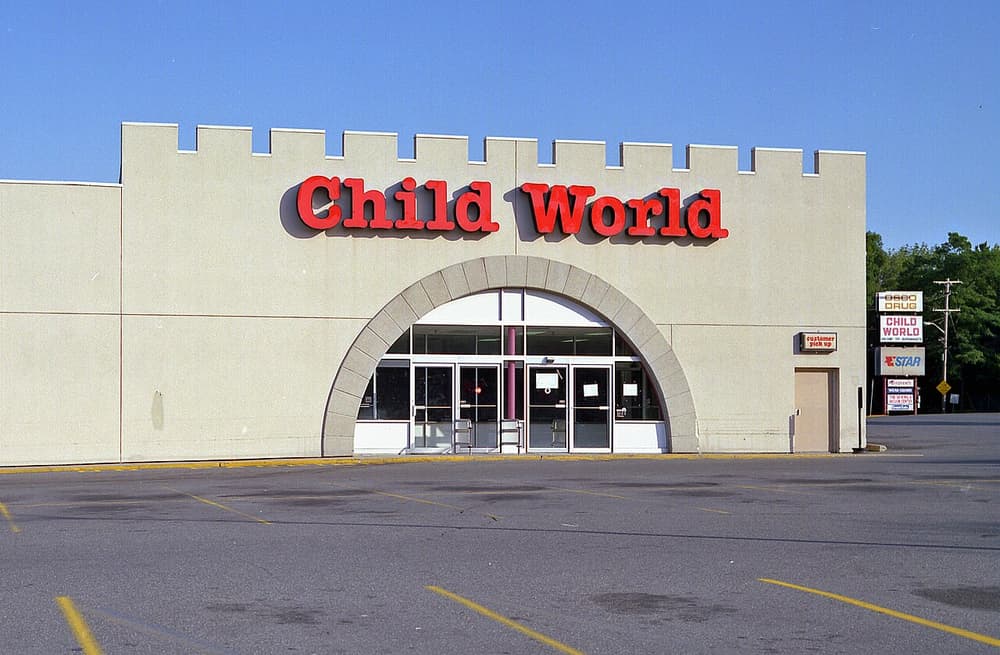
An empty Child World store with red letters over an arched entrance
The Saugus, Massachusetts store in 1993, after the chain had closed. Photo: Anthony92931, Wikimedia Commons, CC BY-SA 3.0.Photo: Anthony92931, via Wikimedia Commons, CC BY-SA 3.0.
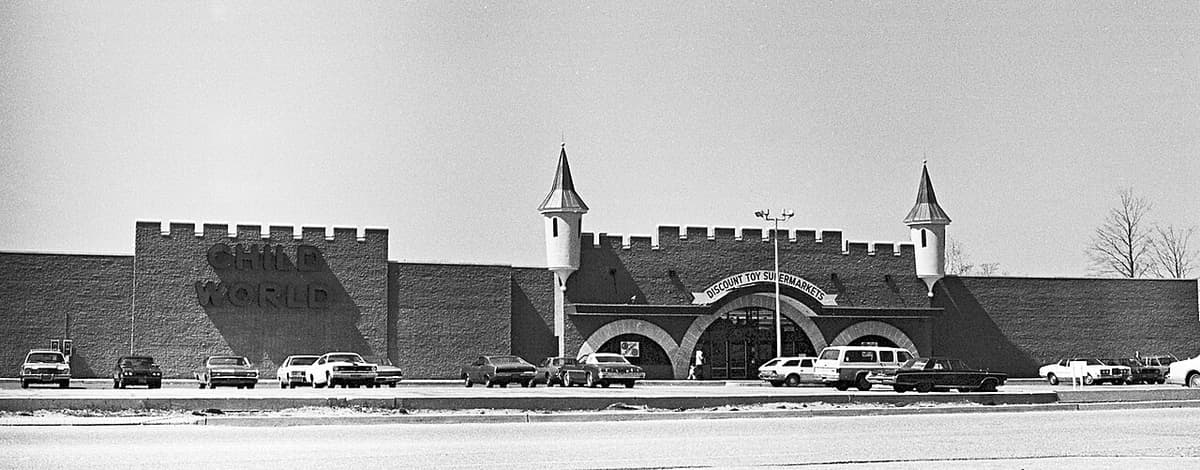
A long Child World store with castle battlements and two white turrets
The Child World “discount toy supermarket” at South Shore Mall, Bay Shore, New York, April 1979. Photo: Downtowngal, Wikimedia Commons, CC BY-SA 4.0.Photo: Downtowngal, via Wikimedia Commons, CC BY-SA 4.0.

Child World was founded in Quincy, Massachusetts, in 1962 and grew into the country’s second-largest toy retailer, with Children’s Palace stores alongside its own. Cole National bought it in 1981 and floated 18% of it in 1985; then Cole itself went through two leveraged buyouts. By 1990 the chain had about 180 stores, was losing money against Toys “R” Us, and was for sale. Roy Disney’s Trefoil walked away on Thanksgiving Day. Two weeks later Child World stopped paying $122M of bank debt and $212M owed for merchandise. Former Toys “R” Us executives took control in 1991, but in May 1992 it filed for Chapter 11, and by the autumn every store was closed. This page is built from contemporary reports in the Los Angeles Times, UPI and the New York Times, and the bankruptcy court’s own findings.

The chain in four numbers

182
stores in January 19915
$192M
reported loss on $830M of sales in 199012
$122M + $212M
bank debt and merchandise bills it stopped paying in December 19905
4,800
employees on the day it filed for bankruptcy10

Key findings

  1. It was a copy of the leader. A trade editor said in 1990 that Child World had not set itself apart from Toys “R” Us “and they got their heads handed to them.”2 Toys “R” Us held about a quarter of the $13.5 billion American toy market.2
  2. Its owner needed the money more than it did. Its parent, CNC Holding, the former Cole National, had been through two leveraged buyouts and was trying to sell Child World to cut its own debt. It could not pay to remodel or expand the chain.2312
  3. One lost buyer started the run. Trefoil backed out on Thanksgiving 1990 and the shares nearly halved. Two weeks later the chain stopped paying its banks and suppliers, and Mattel and Tyco were projected to take $46M of bad debts between them.35 (derived)
  4. The rescue lasted a year. Former Toys “R” Us executives took control in 1991. In January 1992 the chain closed 26 stores in Chicago and Texas; in May it filed for bankruptcy; by autumn it was gone.16710

The story

From Quincy to 182 castles, and back to none

Child World spent two decades growing and two years dying. The dying began in a boardroom in Cleveland.

Chapter 1 of 5

1962

the year Child World was founded in Quincy, Massachusetts

Child World store with battlements, turrets and a ‘Discount Toy Supermarkets’ sign
Bay Shore, New York, April 1979. Photo: Downtowngal, via Wikimedia Commons, CC BY-SA 4.0.

1962 – 1980 · The toy supermarket

Castles and a roller-skating panda

Child World was founded in 1962 by Sid Shneider and Joseph Arnesano in Quincy, and later moved its headquarters to Avon, Massachusetts.11 Its stores had white brick fronts and red-topped turrets, and its mascot was Peter Panda, who arrived on roller skates in its commercials.11 It later bought the Children’s Palace chain.11

The stores called themselves “discount toy supermarkets,” the same big-box formula as Toys “R” Us.

Chapter 2 of 5

18%

of Child World sold to the public in 1985

Commercial · 1981Child World ad, 1981 The year is the uploader’s. Watch on YouTube

1981 – 1989 · Inside a leveraged parent

Cole National’s “highest-profile deal”

Cole National, the Cleveland key-cutting and optical company, bought Child World in 1981, when it ranked second only to Toys “R” Us among toy supermarket chains.12 Kohlberg Kravis Roberts took Cole private in a leveraged buyout in 1984; in 1985 Cole sold 18% of Child World to the public, when the chain had more than 100 stores in 21 states. In 1987 a group led by Jeffrey Cole took on more debt to regain control, forming CNC Holding.12

That left Child World inside a parent that, by 1990, was “struggling under heavy debt and unable to remodel and expand the chain.”2

Chapter 3 of 5

$5

the share price after Trefoil pulled out, down from $9.75

Commercial · 1987Children’s Palace commercial, 1987 An ad for Child World’s second chain, from the year CNC Holding was formed.12 The year is the uploader’s. Watch on YouTube

1990 · The year it was for sale

Roy Disney’s firm walks away

CNC began trying to sell Child World in March 1990. In July, Trefoil Capital Investors, a fund run by Roy E. Disney’s Shamrock Holdings, offered to swap debt securities for CNC’s 82% stake and pay $14 a share for the rest.3 Trefoil opened a showpiece store in Torrance, California with a carousel and neon skylights, the first of as many as 20 in the state.2

Child World lost $16M on sales of $280.9M in the six months to August 4, against $10.3M a year earlier.3 On Thanksgiving Day Trefoil abandoned the deal without explanation; the next day the shares fell $4.75 to $5.3

Chapter 4 of 5

$334M

of bank debt and merchandise bills suspended in December 1990 (derived)

Commercial · 1987Children’s Palace / Child World commercial with Big Bird, 1987 A joint spot for both names. The year is the uploader’s. Watch on YouTube

Dec 1990 – 1991 · The cash runs out

Unpaid toy makers and a new owner

On December 4, 1990 Child World reported a third-quarter loss of $14.4M and suspended payments on more than $122M of bank debt and $212M owed for merchandise. It cut prices to raise cash, selling an estimated $105M of stock before Christmas.45 Mattel and Tyco were projected to report bad-debt exposure of $20M and $26M.5 Its chairman and then its chief executive resigned.5

In March 1991 a group led by two former Toys “R” Us executives, W. John Devine and Ronald Tuchman, agreed to take control. Public shareholders, who had been offered $14 a share months earlier, would get $2.67

Chapter 5 of 5

125 → 0

stores, from the bankruptcy filing to the autumn

Closed Child World store in Saugus
Saugus, Massachusetts, 1993. Photo: Anthony92931, via Wikimedia Commons, CC BY-SA 3.0.

1992 · The end

Chapter 11, Lionel, and liquidation

In January 1992 the chain closed 16 stores in Chicago, 10 in Houston and Dallas and three distribution centres, taking a $20M charge.1 In May it filed for Chapter 11 in White Plains, New York, closing 54 of its 125 stores, mostly in the Midwest and South, and keeping 71 in the Northeast.1 About 1,500 workers were to be laid off.8 “We have taken decisive action to remove the uncertainty and doubt that have hung over this company for nearly 18 months,” Devine said.1

In June it confirmed merger talks with Lionel Corp., itself in Chapter 11, and warned that it would close its 71 stores if they failed.9 They failed. The bankruptcy court recorded that Child World had decided to liquidate and expected its going-out-of-business sales to finish by the end of October 1992.1013

Timeline

Thirty years, 19 moments

From one store in Quincy to the No. 2 toy chain in America, and from a failed sale to an empty castle. Filter by thread.

All 19 events as a list
  1. 1962
    Stores

    Founded

    Sid Shneider and Joseph Arnesano found Child World in Quincy, Massachusetts.11

  2. 1981
    Owners & deals

    Cole National buys it

    Child World is then second only to Toys “R” Us among toy supermarkets.12

  3. 1984
    Owners & deals

    KKR takes Cole private

    Child World’s parent goes through a leveraged buyout.12

  4. 1985
    Money

    18% floated

    Cole sells 18% of Child World to the public; the chain has more than 100 stores in 21 states.12

  5. 1987
    Owners & deals

    CNC Holding

    Jeffrey Cole’s group takes on more debt to regain control of the parent.12

  6. Mar1990
    Owners & deals

    For sale

    CNC begins trying to sell Child World.3

  7. Jul1990
    Owners & deals

    Trefoil’s offer

    Roy Disney’s Trefoil offers debt securities for CNC’s 82% and $14 a share for the public’s 18%.3

  8. Oct 251990
    Stores

    Torrance

    A prototype store opens in Torrance, the first of up to 20 planned in California.2

  9. Nov 221990
    Bankruptcy & end

    Trefoil walks

    The offer is abandoned on Thanksgiving Day; the shares fall to $5 the next day.3

  10. Dec 41990
    Bankruptcy & end

    Payments suspended

    A $14.4M third-quarter loss; payments stop on $122M of bank debt and $212M of merchandise.45

  11. Jan1991
    Owners & deals

    The bosses leave

    The chief executive resigns, weeks after the chairman. Mattel and Tyco brace for bad debts.5

  12. Mar 131991
    Owners & deals

    Toys “R” Us veterans

    W. John Devine and Ronald Tuchman’s WC Acquisition emerges as the buyer.6

  13. Apr 81991
    Money

    $2 a share

    CNC agrees to sell its 82%; public holders are to get $2 a share.7

  14. Jan1992
    Stores

    26 stores shut

    Chicago, Houston and Dallas stores and three distribution centres close; a $20M charge.1

  15. May 61992
    Bankruptcy & end

    Chapter 11

    Child World files in White Plains, closing 54 of 125 stores; about 1,500 jobs go.1810

  16. Jun1992
    Owners & deals

    Lionel talks

    A merger with Lionel is proposed; otherwise the last 71 stores will close.9

  17. Aug1992
    Bankruptcy & end

    Talks fail

    Child World says it will close its remaining stores.13

  18. Oct 301992
    Bankruptcy & end

    Nearly over

    The bankruptcy court records that the closing sales will finish within the month.10

  19. 1993
    Stores

    Empty castles

    The Saugus, Massachusetts store stands empty.

The money

Rising sales, rising losses

Child World’s own annual reports from this period are not on SEC EDGAR, which begins later. The figures here are as reported at the time by the Los Angeles Times and UPI, and by a business-history reference for 1990.

Stores, 1985 to 1992

Store counts as reported at each date.

0501001502001985Nov 1990Jan 1991May 1992After closingsAutumn 1992123401002001985Jan 1991Autumn 19921234
  1. 1985 · public “Over 100 stores in 21 states” when 18% was floated.12
  2. Jan 1991 · the peak 182 stores.5
  3. May 1992 · Chapter 11 125 stores; 54 to close.1
  4. Autumn 1992 · liquidation Closing sales due to finish in October.10
Data table
Stores, 1985 to 1992
Not evenly spacedStores
1985100
Nov 1990176
Jan 1991182
May 1992125
After closings71
Autumn 19920
Reported counts.1351012 The 1985 figure is a floor (“over 100”). The Nov 1990 and Jan 1991 counts come from different reports.

Losses in 1989 and 1990

$ millions, as reported.

Data table
Losses in 1989 and 1990 (Net loss)
Period19891990
Q2$-5.1M$-8.5M
Q3$-4.1M$-14.4M
First half$-10.3M$-16M
Los Angeles Times, Oct 25, Nov 24 and Dec 5, 1990.234 The first half ended Aug 4, 1990.

What it stopped paying, December 1990

$ millions.

Merchandise owed to suppliers
$212M
Bank debt
$122M
“more than”
Data table
What it stopped paying, December 1990
ObligationAmountNote
Merchandise owed to suppliers$212M
Bank debt$122M“more than”
Los Angeles Times, Jan 25, 1991.5

Toy makers caught out

Analysts’ projections of bad-debt exposure to Child World, January 1991, $ millions.

Tyco Toys
$26M
Mattel
$20M
Data table
Toy makers caught out
CompanyExposureNote
Tyco Toys$26M
Mattel$20M
Los Angeles Times, Jan 25, 1991. Hasbro also said its quarter would be hit, by an amount it did not give.5

The price of a toy chain

$14
a share offered by Trefoil for public stock, July 19903
$5
the share price after Trefoil withdrew, November 19903
$2
a share offered by WC Acquisition, March 19916
$830M
1990 sales, on which it reportedly lost $192M12
Los Angeles Times, UPI and Reference for Business.3612
Child World store with battlements and turrets, 1979
Apr 1979 South Shore Mall, Bay Shore, New York: a “discount toy supermarket.”Photo: Downtowngal, via Wikimedia Commons, CC BY-SA 4.0.

Part 3 of 6

Brand

Commercials & footage · Brand gallery

Commercials & footage

Peter Panda on roller skates

Child World and Children’s Palace advertised on local television across the Northeast and Midwest. These spots were uploaded by collectors; dates are the uploaders’ unless a caption says otherwise.

Commercial · 1980Child World toy store commercial, 1980 A spot from the year before Cole National bought the chain.12 The year is the uploader’s. Watch on YouTube
Commercial · 1981Child World ad, 1981 The year is the uploader’s. Watch on YouTube
Commercial · 1983Child World ad, 1983 The year is the uploader’s. Watch on YouTube
Commercial · 1987Children’s Palace commercial, 1987 An ad for Child World’s second chain, from the year CNC Holding was formed.12 The year is the uploader’s. Watch on YouTube
Commercial · 1987Children’s Palace / Child World commercial with Big Bird, 1987 A joint spot for both names. The year is the uploader’s. Watch on YouTube
Retrospective · 2021CBS Boston: The story of toy store giant Child World The December 2021 report that accompanies the CBS Boston article we cite for the founding.11 Watch on YouTube

Videos are embedded from the services that host them and load only when you press play. YouTube embeds use youtube-nocookie.com. Each video belongs to its uploader or rights holder and is shown here for commentary; we do not host any of the files.

The clippings

What they said at the time

Press (3)
…and they got their heads handed to them.
Larry Carlat, editor of Toy & Hobby World, on Child World’s failure to set itself apart from Toys “R” Us, Los Angeles Times, Oct 25, 19902
  1. Stanley P. Gold, Shamrock Holdings, a month before Trefoil walked away, Oct 19902

    We make investments in things people don’t like.
  2. Sally Schaadt, toy analyst, Fourteen Research, May 19921

    The toy market may be what dreams are made of, but it is one tough industry.

Part 5 of 6

Verdict

Cause of death · What if · Afterlife

Cause of death

The autopsy

Tap a cause to see the evidence. The percentages are our editorial weighting. The evidence under each one is sourced.

Cause of death, by editorial weight

One square is one percentage point. The weights are our judgment, not a measurement.

  1. 35%A second Toys “R” Us
  2. 30%An over-borrowed parent
  3. 20%A failed sale, then a cash crisis
  4. 15%Recession
Data table
Cause of death, by editorial weight
CauseWeight
A second Toys “R” Us35%
An over-borrowed parent30%
A failed sale, then a cash crisis20%
Recession15%

Child World used the same toy-supermarket format as the market leader, which had about a quarter of American toy sales. A trade editor said it had not differentiated itself “and they got their heads handed to them.” Its profit margin was “eroded by intense price competition.”24

Cole National went through a leveraged buyout in 1984 and took on more debt in 1987. By 1990 the parent was struggling with heavy debt, could not fund remodelling, and was selling Child World to cut its own borrowings.2312

When Trefoil walked away in November 1990 the shares halved. Within two weeks Child World had stopped paying $122M of bank debt and $212M to suppliers, and toy makers began writing off what it owed.35

An analyst blamed “a combination of the depressed economy, a strong company like Toys ’R’ Us and the lack of consumer spending” when it filed in 1992.1

Editorial judgment: The weights are our judgment of how much each factor contributed. Reasonable readers could weigh them differently.

The fork in the road

What if…

Three decisions where the story could have gone differently. The “What if” panels are speculation, labeled as such.

What happened

Roy Disney’s Trefoil abandoned its offer on Thanksgiving Day 1990, citing nothing.3

What if speculative

A well-funded owner with retail experience might have paid suppliers through Christmas 1990 and avoided the payment freeze. Its showpiece Torrance store suggests it would have tried to make Child World less like Toys “R” Us.

What happened

In 1990 the chain had 176 stores in 31 states. In 1992 it kept only 71 in the Northeast, which it called its profitable core.13

What if speculative

Retreating to the Northeast years earlier, while the parent still had money, might have left a smaller but solvent chain. It would still have faced Toys “R” Us in every market it kept.

What happened

Talks with Lionel in mid-1992 would have created a 135-store chain; they failed.913

What if speculative

Two bankrupt toy chains combined would have had scale but no money. It is not clear that the merger could have survived the next Christmas.

Where are they now

The afterlife

Child World

  1. The stores

    Liquidated

    54 stores closed with the May 1992 filing; the remaining 71 were liquidated after the Lionel talks failed, with sales expected to end in October 1992.11013

  2. The employees

    Unpaid

    About 4,800 people worked for Child World when it filed. In October 1992 the court allowed it to reject 22 key employees’ contracts, turning their salary-continuation claims into unsecured debts.10

  3. Peter Panda

    Remembered

    A Peter Panda costume is kept by the Avon historical society, and a local historian puts it in the window at night.11

  4. The name

    Gone

    We found no later owner or use of the Child World name in our sources.

Who owned Child World

  1. 1962

    Sid Shneider and Joseph Arnesano

    Found the chain in Quincy.11

  2. 1981

    Cole National

    Buys the No. 2 toy supermarket chain.12

  3. 1985

    Cole National (82%) and public (18%)

    Minority stake floated.12

  4. 1987

    CNC Holding (82%)

    Cole National’s new holding company after a second buyout.12

  5. 1991

    Banks and Avon Investors LP (82%)

    Recapitalization led by former Toys “R” Us executives.17

  6. May 1992

    Child World, in Chapter 11

    Files in White Plains, New York.10

Data table
Who owned Child World
WhenOwnerWhat happenedPrice
1962Sid Shneider and Joseph ArnesanoFound the chain in Quincy.
1981Cole NationalBuys the No. 2 toy supermarket chain.
1985Cole National (82%) and public (18%)Minority stake floated.
1987CNC Holding (82%)Cole National’s new holding company after a second buyout.
1991Banks and Avon Investors LP (82%)Recapitalization led by former Toys “R” Us executives.
May 1992Child World, in Chapter 11Files in White Plains, New York.
UPI, Los Angeles Times, Reference for Business and the bankruptcy court.171012

Sources & data notes

Show your work

Child World’s filings from this period predate SEC EDGAR’s online archive, so this page relies on contemporary wire and newspaper reports, the bankruptcy court’s published decision and a business-history reference. Every link was opened while this page was researched, except where noted.

  1. “Child World files Chapter 11; closes stores”, UPI, May 7, 1992.
  2. Jesus Sanchez, “Is Child World Just a Plaything for Shamrock?”, Los Angeles Times, Oct 25, 1990.
  3. James F. Peltz, “Roy Disney Firm Scraps Plan to Buy Child World”, Los Angeles Times, Nov 24, 1990.
  4. “Child World Posts Loss, May Sell”, Los Angeles Times, Dec 5, 1990.
  5. “Chief Executive of Child World Resigns”, Los Angeles Times, Jan 25, 1991.
  6. Barry Flynn, “Child World bidder says sale agreement in days”, UPI, Mar 13, 1991.
  7. “CNC to sell Child World stock to WC Acquisition”, UPI, Apr 8, 1991.
  8. “No. 2 Toy Retail Chain Files for Bankruptcy”, Los Angeles Times, May 8, 1992.
  9. “Child World Confirms Talks With Lionel”, Los Angeles Times, Jun 12, 1992.
  10. In re Child World, Inc., 147 B.R. 847 (Bankr. S.D.N.Y. Oct 30, 1992), decision on motion to reject key employee contracts.
  11. “‘It Was An Unmistakable Experience,’ Remembering Local Toy Store Giant Child World”, CBS Boston, Dec 13, 2021.
  12. “Cole National Corporation: History”, Reference for Business (from the International Directory of Company Histories).
  13. “Company News; Child World Will Close as Talks With Lionel Fail”, The New York Times, Aug 5, 1992. Cited for its headline; the article body was not accessible to us.
Data notes (6)

Data notes

Derived: $334M is the $122M of bank debt plus the $212M owed for merchandise reported by the Los Angeles Times.5 $46M is the sum of the projected Mattel ($20M) and Tyco ($26M) exposures.

Conflicts: The court’s decision dates the petition May 6, 1992; UPI, writing on May 7, said the company filed “Thursday,” which was May 7.110 Reports call Child World the second-largest toy chain (UPI, May 1992) and the third-largest (Los Angeles Times, June 1992).19 The Times put remaining staff at about 4,000 after 1,500 layoffs; the court says about 4,800 at the petition.810 Reference for Business says CNC sold Child World to “a coalition of former Toys-R-Us executives”; UPI says the 1991 recapitalization sold 82% to its banks and Avon Investors LP, a partnership controlled by Thomas H. Lee Co.112 Store counts in late 1990 are given as 176 and 182.35

Secondary: The 1990 loss of $192M on $830M of sales and the 1981 and 1985 dates come from Reference for Business, a secondary history; we have not seen the underlying filings.12

Unknown: Annual sales and profits before 1989; the exact date the last store closed; what creditors recovered.

Videos: Commercial dates are the uploaders’. The CBS Boston report accompanies the article we cite.

Images: Both photographs are from Wikimedia Commons under the licences in their credits. The swatches are approximations. The drawing is original.