Spectre Brands

GhostReformulated cola · Atlanta, Georgia

New Coke

Announced April 23, 1985. Old formula restored July 1985. Renamed Coke II from 1990. Withdrawn in the early 2000s.

The taste tests said people preferred it. Nobody had asked them how they would feel if the old one was taken away.

Why ghost: Coca-Cola took the 1985 formula off the market in the early 2000s, but in 2019 it partnered with Netflix “to temporarily bring back 1985’s New Coke” in a limited run of cans for “Stranger Things”; we found nothing sold under the name since.212531

COLA NEW!
Original illustration of a red can with a silver wave. Not an official asset and not the trademarked design.

On April 23, 1985 the Coca-Cola Company replaced the formula of its flagship drink with a sweeter one that had won blind tests of nearly 200,000 people. Within weeks its hotline was taking 1,500 calls a day. On July 10 the company said the old formula would come back as Coca-Cola Classic, and the new one became the smaller of two Cokes, then Coke II, then nothing. This is the post-mortem, built from the wire reports of 1985, the company’s own published account and later reporting.

The product in four numbers

79
days between the launch of the new formula and the return of the old one, by Coca-Cola’s own count1
200,000
consumers, nearly, in the taste tests that favored the new formula; a spokesman said “over 190,000” at the time14
1,500
calls a day to the consumer hotline by June 1985, against 400 a day before the change15
31,600
calls to the hotline in the two days after the old formula’s return was announced1

Key findings

  1. The research was large, and it was about taste. A spokesman said more than 190,000 people preferred the new formula 55–45 blind and 61–39 when told what it was.4 Coca-Cola now says the tests did not show “the bond consumers felt with their Coca-Cola.”1
  2. It did not join the old Coke. It replaced it. Production of the original stopped in April 1985.7 The complaint that followed was about the loss as much as the flavor.
  3. Trial was high and so was the noise. By June the company said 110 million people had tried it and about 80% would buy it again, while taking 1,500 mostly negative calls a day.5
  4. The reversal took 79 days. The return of the old formula as Coca-Cola Classic was announced on July 10, 1985; Coca-Cola stock rose $2.37 that day.68
  5. The new formula outlived its failure by years. It stayed on sale as “Coke,” was tested as Coke II in Spokane in 1990, and was withdrawn in 2002 or 2004, depending on the source.131921

The story

Seventy-nine days, and seventeen years after that

New Coke is remembered as a product that lasted one summer. The decision lasted one summer. The drink itself stayed on shelves, under two names, until the early 2000s.

Chapter 1 of 5

21.7%

Coke’s share of the US soft drink market before the change, against 18.8% for Pepsi, per Beverage Digest

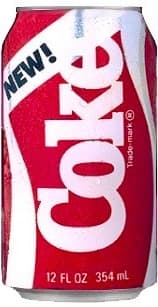
A red soft drink can with a silver wave, the word Coke in white and a yellow NEW! flash
A New Coke can. Undated photo by Jetijonez, via Wikimedia Commons, public domain.30

1980 – Apr 1985 · The reason

A lead that had been shrinking for fifteen years

Coca-Cola’s own account of 1985 starts with a problem: its share lead over Pepsi, “in its flagship market, with its flagship product, had been slowly slipping for 15 consecutive years.”1 In July 1985 UPI put the two brands at 21.7% and 18.8% of a $23-billion-a-year industry, citing Beverage Digest.6 Time wrote that the overall lead survived because of Coke’s strength in fountains and vending machines, and that each share point was worth about $200 million in sales.8

Company officials said researchers came across the new taste in 1980 while working on a formula for Diet Coke.6 It was then tested on a scale few products have been: nearly 200,000 consumers over three years.18 A spokesman gave the result as 55–45 for the new taste in blind tests, and 61–39 when tasters were told which was which.4

Chapter 2 of 5

99 years

how long the formula had gone unchanged, as reported on the day

News segment · 1985CBS Evening News: Coca-Cola launches new Coke A two-minute network report on the formula change, posted by the CBS Evening News channel under the title “1985: Coca-Cola launches new Coke.” The announcement was on April 23, 1985.129 Watch on YouTube

Apr 23, 1985 · The launch

The first change in 99 years

The day before, The Washington Post reported that the company “wouldn’t say what its momentous announcement will be,” and that speculation centered on a smoother, sweeter formula.2 On April 23 in New York, Coca-Cola “introduced the first major change in Coke’s legendary secret formula in its 99-year history.”3 The event was at Lincoln Center, with chairman Roberto Goizueta and president Donald Keough toasting the new drink.27 A later history quotes Goizueta calling it “the surest move ever made.”23

The old formula was not kept as an option. Production stopped that April.7 Pepsi declared a company holiday.6 Its US president, Roger Enrico, said in a full-page advertisement that “the other guy just blinked.”24

After 87 years of going at it eyeball to eyeball, the other guy just blinked.

Roger Enrico, president of Pepsi-Cola U.S.A., in a newspaper advertisement, as quoted by The Washington Post24

Chapter 3 of 5

1,500

calls a day to Coca-Cola’s hotline by June, against 400 before the change

The hotline, 800-GET-COKE, went from 400 calls a day to 1,500.1 Original illustration, not an official asset.

May – Jun 1985 · The backlash

Fifteen hundred calls a day

At the end of May the company asked employees to volunteer for overtime on its toll-free line. A spokesman said the reaction was “mixed.” The same day its newspaper advertisements claimed that 200 million people knew about the new taste and more than 80 million had tried it.4

By June 10 the count was 1,500 calls a day, and the president of Coca-Cola USA, Brian Dyson, said most were negative. He also said 110 million people had tried the drink, that about 80% said they would buy it again, and that the company had an 18-month marketing plan, the costliest in its history.5 Pepsi’s advertisements said its May sales were up 14%, its best month ever.5

In Seattle, Gay Mullins founded Old Cola Drinkers of America, which claimed 100,000 recruits, and sued to force the old drink back; the suit was thrown out.16 People stockpiled. A man in San Antonio bought $1,000 worth from a bottler, and a Beverly Hills wine merchant sold 500 cases of old Coke at $30 each.18 A Chicago research firm found that 59% of soft drink buyers who had tasted the new Coke thought the original was better.6

Does it (negative response) concern us? Absolutely. We like to please all of the people all of the time.

Brian Dyson, president of Coca-Cola USA, UPI, Jun 10, 19855

Chapter 4 of 5

79 days

from April 23 to the return of the original formula, as Coca-Cola counts it

Event · 1985Donald Keough announces Coca-Cola Classic Nearly six minutes of the company president’s remarks on the return of the original formula, uploaded by the channel CokeConversations as “Don Keough Speech Classic Coke.” The press conference was on July 11, 1985; the upload itself gives no date for the footage.129 Watch on YouTube

Jul 10 – 11, 1985 · The retreat

“We have listened”

On Wednesday, July 10, Coca-Cola announced that it would bring the old drink back “within the next few weeks” as Coca-Cola Classic, to be sold alongside the new one.6 ABC’s Peter Jennings interrupted the soap opera “General Hospital” with the news.23 Coca-Cola stock rose $2.37 a share and PepsiCo’s fell 75 cents.8 Goizueta and Keough faced the press in Atlanta the next day.1618

In the two days after the announcement the hotline took 31,600 calls.1 UPI reported on July 24 that the company had resumed manufacturing the original formula.7 Coca-Cola said the very first case would go to Mullins.27

The passion for original Coca-Cola — and that is the word for it, passion — was something that caught us by surprise.

Donald Keough, president of Coca-Cola, at the July 11, 1985 press conference, as quoted by Snopes16

Chapter 5 of 5

0.1%

share of the market left to the 1985 formula by 1999, according to one later account

NEW CLASSIC
From July 1985 there were two: the new formula, still called Coke, and the old one, called Classic.6 Original illustration; the lettering is ours.

1985 – 2002 · The long tail

The smaller of two Cokes

The two drinks got separate campaigns: “Catch the Wave” for the new taste and “Red, White and You” for Classic.1 Classic outsold the new formula, which by one later account settled at about a 3% share in its first year.16 The company did well regardless. In 1986 it reported net income up 29% to $934 million and a domestic share above 39%, which it called a record.11

In March 1990 Coca-Cola said it would test the drink under a new name, Coke II.12 It went on sale in the Spokane area that April, with the same taste and new packaging. A brand director called it “the Coke for Pepsi drinkers.”13 Later accounts say the name was used more widely from 1992 and that fewer and fewer bottlers made it.2122

The end is not well recorded. Mental Floss and The Henry Ford museum give 2002; the Associated Press wrote in 2009 that it “was sold sparingly until it was dropped in 2004.”192122 In January 2009 the company began taking the word “Classic” off its labels.1920

It’s the Coke for Pepsi drinkers.

Donald Lenehan, Coca-Cola group brand director for cola brands marketing, Lewiston Tribune, Apr 14, 199013

Timeline

One hundred and thirty-three years, 29 moments

From a pharmacy in Atlanta to a vending machine in New York. Filter by thread.

All 29 events as a list
  1. May 8, 18861886
    Product

    The first glass

    John Pemberton sells the first glass of Coca-Cola for a nickel at an Atlanta pharmacy soda fountain. First-year revenues are $35.9

  2. 19801980
    Product

    A new taste, found by accident

    Company officials later say researchers came across the formula while working on Diet Coke.6

  3. Before 19851984
    Product

    The tests

    Nearly 200,000 consumers are asked to compare formulas over a three-year period, by Time’s account. The new one wins 55–45 blind.148

  4. 19841984
    Money & share

    21.7% to 18.8%

    Coke’s share of the US soft drink market against Pepsi’s, per Beverage Digest figures quoted in July 1985. Coca-Cola’s sales for the year are $7.4 billion and its profit $629 million.46

  5. Apr 22, 19851985
    Product

    A “momentous announcement” is promised

    Coca-Cola will not say what it is. Speculation centers on a smoother, sweeter formula.2

  6. Apr 23, 19851985
    Product

    The formula changes

    In New York, Coca-Cola introduces the first major change to the formula in 99 years. The new drink goes on sale and production of the old one ends.1347

  7. Apr 19851985
    Rivals

    Pepsi takes a holiday

    Pepsi declares a company holiday and Roger Enrico’s advertisement says “the other guy just blinked.”624

  8. May 19851985
    Backlash

    Protest in Atlanta

    Demonstrators at a Coca-Cola event downtown carry signs reading “We want the real thing.”1

  9. May 31, 19851985
    Backlash

    Overtime on the hotline

    Employees are asked to volunteer for extra shifts. Company advertisements claim more than 80 million people have tried the new taste.4

  10. Early Jun 19851985
    Rivals

    Pepsi’s best month

    Pepsi advertisements say May sales were up 14%, the highest for any month in its history.5

  11. Jun 10, 19851985
    Backlash

    1,500 calls a day

    Brian Dyson says most are negative, and that 110 million people have tried the drink.5

  12. Jul 10, 19851985
    Decline

    The old formula will return

    Coca-Cola announces Coca-Cola Classic, to be sold beside the new Coke. Its stock rises $2.37.68

  13. Jul 11, 19851985
    Decline

    The press conference

    Goizueta and Keough explain the decision in Atlanta. The hotline takes 31,600 calls in two days.11618

  14. Jul 24, 19851985
    Product

    Production of the original resumes

    UPI reports from Washington state, where Gay Mullins celebrates.7

  15. Aug 15, 19851985
    Backlash

    The sugar lobby joins in

    The Sugar Association runs full-page advertisements arguing that Classic, sweetened with corn syrup, is not the original either.27

  16. Late 19851985
    Money & share

    Two Cokes split the vote

    By one later account, year-end surveys showed Pepsi ahead of the two Cokes; the new formula settled near 3%.16

  17. Early 19861986
    Money & share

    Classic retakes first place

    The same account says Classic reclaimed the lead among sugar colas early in the year.16

  18. May 8, 19861986
    Money & share

    The centennial

    Coca-Cola’s stock has gone from an all-time high of $74.75 to more than $115 since the reversal. Keough: “It all kind of worked out.”9

  19. Jun 19861986
    Rivals

    About 39% to about 29%

    Company shares of the soft drink market for Coca-Cola and PepsiCo, as the FTC moves to block their bids for Dr Pepper and Seven-Up.10

  20. Feb 19, 19871987
    Money & share

    A record year

    Coca-Cola reports 1986 net income of $934 million, up 29%, and a domestic share above 39%.11

  21. Mar 19901990
    Product

    A new name is announced

    Coca-Cola says it will test-market the 1985 formula as Coke II later in the year.12

  22. Apr 19901990
    Product

    Coke II reaches Spokane

    Same taste, new packaging and advertising, on test in northeastern Washington and northern Idaho.13

  23. Jan 25, 19911991
    Money & share

    Classic 19.4%, Pepsi 17.3%

    Brand shares for 1990 as reported by Beverage Industry magazine. The report does not list the new formula.14

  24. 19921992
    Product

    Coke II spreads, a little

    Later accounts date the wider use of the Coke II name to 1992. We found no contemporary report we could open.2122

  25. 19951995
    Afterlife

    A tenth-anniversary party

    Goizueta tells employees the decision was an example of “taking intelligent risks.”1

  26. May 19991999
    Decline

    Down to 0.1%

    Snopes writes that the drink, now Coke II, “holds onto a 0.1% market share.”16

  27. 20022002
    Decline

    Withdrawn

    Two later accounts give 2002 as the end of Coke II. The Associated Press gives 2004.192122

  28. Jan 30, 20092009
    Afterlife

    “Classic” comes off the label

    A spokesman says the reason for the word “has all but disappeared.” Canada had dropped it in 2007.1920

  29. May 21, 20192019
    Afterlife

    Back for “Stranger Things”

    Coca-Cola and Netflix announce a limited run of New Coke cans, on sale from May 23 and dispensed free from pop-up vending machines.252631

Part 2 of 6

Business

The numbers · Marketing · Rivals

The numbers

What the tests said, what the phones said and what the company earned

Coca-Cola has never published sales of the 1985 formula as a separate line. What exists is its own research claims, call counts, share figures from trade publications quoted in the press, and the company’s results. This section keeps them apart.

Four figures, four different kinds of source

55–45
The company’s research: the margin for the new taste in blind tests of more than 190,000 people, as a spokesman gave it in May 1985.4
59%
An outside survey: the share of soft drink buyers who had tasted the new Coke and thought the original was better, per Leo J. Shapiro, a Chicago research firm.6
1,500
The company’s call count: calls a day to its hotline by June 1985, most of them negative.15
3%
A later secondary account: the share at which the new formula settled in its first year.16 We could not open a contemporary source for it; treat as unverified.

The drink called “Coke,” from inheritance to nothing

Share of the US soft drink market held by the 1985 formula, in percent. The second point is the share it inherited from the old formula, not one it earned.

0%10%20%30%Before Apr 1985Apr 1985First year1999After withdrawal123450%10%20%30%Before Apr 1985Apr 1985First year1999After withdrawal12345
  1. Before Apr 1985 · not on sale The formula exists only in tests. Plotted as zero.
  2. Apr 1985 · inherits the flagship It replaces a drink with 21.7% of the market, per Beverage Digest figures quoted by UPI.6
  3. First year · the smaller Coke With Classic back, it settles at about 3%, by one later account.16
  4. 1999 · Coke II Sold in a few markets, it “holds onto a 0.1% market share.”16
  5. After withdrawal · withdrawn Gone in 2002 or 2004, depending on the source.1921 Plotted as zero.
Data table
The drink called “Coke,” from inheritance to nothing
Share of US soft drink market (%)Share of market
Before Apr 19850%
Apr 198521.7%
First year3%
19990.1%
After withdrawal0%
UPI, Jul 10, 19856; Snopes, 199916. The series mixes a trade figure for the old formula’s share with two figures from a later secondary account, and the end points are plotting conventions. The Coca-Cola Company published no share data for the brand that we found.

The same formula, asked four ways

Percent preferring the new taste in each test or survey.

Company test, tasters told which was which
61%
61–39.4
Company test, blind
55%
55–45, more than 190,000 people.4
Company test, blind, in the South
52%
52–48, as reported by Mother Jones in 2019.27
Outside survey after launch (derived)
at most 41%
59% said the original tasted better.6 100 − 59 = 41, an upper bound.
Data table
The same formula, asked four ways
TestPreferred the new tasteNote
Company test, tasters told which was which61%61–39.
Company test, blind55%55–45, more than 190,000 people.
Company test, blind, in the South52%52–48, as reported by Mother Jones in 2019.
Outside survey after launch (derived)at most 41%59% said the original tasted better. 100 − 59 = 41, an upper bound.
UPI, May 31 and Jul 10, 198546; Mother Jones, Jul 9, 201927. The last bar is derived and compares a different question, asked of buyers who knew the old drink was gone.

Two days of calls about the return equaled 79 ordinary days

31,600 callsto the hotline in the two days after Coca-Cola Classic was announced1
=
79 ×a normal day on the hotline before the change1 (400 calls)

Derived 31,600 ÷ 400 = 79. The match with the 79 days the old formula was gone is a coincidence. Per day: 31,600 ÷ 2 = 15,800, about ten times the 1,500 a day of June 1985.1

Data table
Two days of calls about the return equaled 79 ordinary days
Value
to the hotline in the two days after Coca-Cola Classic was announced31,600 calls
a normal day on the hotline before the change400 calls
Ratio79 (derived)
The Coca-Cola Company’s published history.1

The blunder years, on the income statement

The Coca-Cola Company’s net income, in $ millions, as reported by UPI.

Data table
The blunder years, on the income statement
PeriodNet income ($M)
1984$629M
1985$722M
1986$934M
1984: UPI, May 31, 1985 (“a profit of $629 million”).4 1985 and 1986: UPI, Feb 19, 1987.11 The 1986 figure includes gains from selling bottling stock and other transactions, which UPI put at 35 cents of the $2.42 a share. These are results for the whole company, including its entertainment business; nothing in them isolates the new formula.

The company’s share went up

Share of the US soft drink market by company, all brands, as quoted in the press.

Data table
The company’s share went up
PeriodCoca-Cola Co.PepsiCo
198639%29%
199040.4%31.8%
199141%32.8%
1986: “about 39 percent” and “about 29 percent,” The Christian Science Monitor, Jun 27, 1986.10 1990: Beverage Industry magazine figures in UPI, Jan 25, 1991.14 1991: Beverage Digest figures in The Christian Science Monitor, Feb 7, 1992.15 Three different publications’ measures; the years between are not in our sources and the axis does not start at zero.

The money around the edges

Dollar figures from the summer of 1985 and after.

FigureWhat it was
$23 billionAnnual size of the US soft drink industry as UPI gave it in July 1985.6
$200 millionWhat one share point was worth in sales, per Time.8
+$2.37Rise in Coca-Cola’s share price on the day the reversal was announced; PepsiCo fell 75 cents.8
$74.75 → $115Coca-Cola’s stock from its previous all-time high to its level by May 1986, per UPI. A rise of about 54% (derived).9
$30 a caseWhat a Beverly Hills wine merchant charged for 500 cases of old Coke.8
$100,000What Gay Mullins said he spent on the campaign to bring the old drink back. The figure rose with each telling.727

Unknown: sales of the 1985 formula in cases or dollars for any year; what the reformulation, the launch and the reversal cost; and what the 18-month marketing plan was budgeted at. Dyson called it the costliest in the company’s history and gave no number.5

The brand

A wave, a coupon and a computer-generated spokesman

The launch reached almost everyone. What Coca-Cola could not buy was permission to take the old drink away. We have no figure for what the campaigns cost, and we do not guess.

Seven weeks in: who knew, and who had tried it

Americans aware of the change by June 1985, in millions, as estimated by the president of Coca-Cola USA.

200M aware of the change
110M 55%Had tried the new Coke90M 45%Aware, had not tried it (derived remainder)110M 55%Had tried the new Coke90M 45%Aware, had not tried it (derivedremainder)
  • Had tried the new Coke. “About 80 percent said they would repurchase,” Dyson said.5
  • Aware, had not tried it (derived remainder). 200 − 110 = 90.
Data table
Seven weeks in: who knew, and who had tried it
Where it wentAmountShareNote
Had tried the new Coke110M55%“About 80 percent said they would repurchase,” Dyson said.
Aware, had not tried it (derived remainder)90M45%200 − 110 = 90.
Brian Dyson, quoted by UPI, Jun 10, 1985.5 These are the company’s own estimates. The remainder is derived.

Two campaigns for two Cokes

After July 1985 the company advertised both. Its own history describes “the youthful, leading-edge ‘Catch the Wave’ campaign for the new taste of Coke and the emotional ‘Red, White and You’ for Coca-Cola classic.”1

In May the newspaper advertisements had said of those who tried the new taste: “Seventy percent of them can’t wait to get more.”4

The coupon

Callers to the hotline were offered a coupon for a free six- or eight-pack of the new Coke. Dyson said 90% of callers accepted, and read that as willingness to try the product.45

One caller told UPI he had phoned to complain, waited ten minutes on hold and was promised a coupon for the drink he was complaining about.4

Commercial · 1985Bill Cosby for the new taste of Coke A 30-second spot for the reformulated drink. The year is the uploader’s.29 Watch on YouTube
Commercial · 1986Max Headroom: “Catch the Wave” A spot from the “Catch the Wave” campaign, which Coca-Cola says was for the new taste of Coke after Classic returned.1 The year is the uploader’s.29 Watch on YouTube

The 2019 campaign

Thirty-four years later the failure was the selling point. Coca-Cola said Netflix executives visited its archives in Atlanta to study the 1985 packaging and advertising, and that the Duffer Brothers directed an advertisement that put the show’s cast into a 1980s Coca-Cola spot.25 A Coca-Cola director, Peter Shoemaker, was quoted as saying that recreating the product “took about six months and was top secret.”26

The rivals

One competitor outside the company, one inside it

New Coke was built to beat Pepsi. The drink that beat it was the one it had replaced.

Four colas, one casualty

What each was, and what became of it.

New Coke / Coke II

Ghost
Apr 19852002
about 3%, then 0.1% Share in its first year and in 1999, by one later account.16 Withdrawn in the early 2000s; a limited re-release in 2019.2125

Coca-Cola Classic

Alive, as Coca-Cola
19.4% (1990) The old formula, back from July 1985 and the leading brand in 1990.614 The word “Classic” came off US labels from 2009.19

Pepsi

Survived
17.3% (1990) At 18.8% before the change.6 It said May 1985 was its best month ever, and ended the decade behind Classic.514

Diet Coke

Survived
9.1% (1990) The project that produced the new formula, officials said.6 Third among all brands in 1990.14
Data table
Four colas, one casualty
CompanyOutcomeHeadline figureNotesSeries
New Coke / Coke IIGhostabout 3%, then 0.1%Share in its first year and in 1999, by one later account. Withdrawn in the early 2000s; a limited re-release in 2019.0, 21.7, 3, 0.1, 0
Coca-Cola ClassicAlive, as Coca-Cola19.4% (1990)The old formula, back from July 1985 and the leading brand in 1990. The word “Classic” came off US labels from 2009.
PepsiSurvived17.3% (1990)At 18.8% before the change. It said May 1985 was its best month ever, and ended the decade behind Classic.
Diet CokeSurvived9.1% (1990)The project that produced the new formula, officials said. Third among all brands in 1990.
UPI, Jun 10 and Jul 10, 198556; UPI, Jan 25, 1991, citing Beverage Industry magazine14; Snopes16; the Associated Press19. Figures from different publishers are not strictly comparable.

Five years on: the brand table for 1990

Share of US soft drink sales by brand, per Beverage Industry magazine. The 1985 formula is not listed.

Coca-Cola Classic
19.4%
Pepsi
17.3%
Diet Coke
9.1%
Diet Pepsi
6.2%
Dr Pepper
4.8%
Data table
Five years on: the brand table for 1990
BrandShare, 1990Note
Coca-Cola Classic19.4%
Pepsi17.3%
Diet Coke9.1%
Diet Pepsi6.2%
Dr Pepper4.8%
UPI, Jan 25, 1991.14 We read this article through a text-extraction tool that returned its figures as a table; check them against the linked page before reuse.
Commercial · 1985Pepsi: “They changed my Coke” Pepsi’s response in a 30-second commercial. The title and year are the uploader’s. Pepsi said its May 1985 sales were up 14%.529 Watch on YouTube

What Pepsi said

On the day of the reversal a Pepsi spokesman told UPI: “We’re not surprised to hear Coke is reintroducing its old formula because quite clearly the new formula was universally hated.”6 Beverage Digest’s publisher, Jesse Meyers, saw something else in the same decision: a market “getting incredibly diversified,” in which Coca-Cola had found a way “to add another segment.”6

Part 3 of 6

Brand

Commercials & footage · Brand gallery

Commercials & footage

The launch, the apology and the advertising in between

A network news report on the launch, Keough’s speech at the reversal, the advertisements from both sides, and the 2019 revival. Years are the uploaders’ unless a caption says otherwise.

News segment · 1985CBS Evening News: Coca-Cola launches new Coke A two-minute network report on the formula change, posted by the CBS Evening News channel under the title “1985: Coca-Cola launches new Coke.” The announcement was on April 23, 1985.129 Watch on YouTube
Event · 1985Donald Keough announces Coca-Cola Classic Nearly six minutes of the company president’s remarks on the return of the original formula, uploaded by the channel CokeConversations as “Don Keough Speech Classic Coke.” The press conference was on July 11, 1985; the upload itself gives no date for the footage.129 Watch on YouTube
Commercial · 1985Bill Cosby for the new taste of Coke A 30-second spot for the reformulated drink. The year is the uploader’s.29 Watch on YouTube
Commercial · 1985Pepsi: “They changed my Coke” Pepsi’s response in a 30-second commercial. The title and year are the uploader’s. Pepsi said its May 1985 sales were up 14%.529 Watch on YouTube
Commercial · 1986Max Headroom: “Catch the Wave” A spot from the “Catch the Wave” campaign, which Coca-Cola says was for the new taste of Coke after Classic returned.1 The year is the uploader’s.29 Watch on YouTube
Commercial · 2019“Stranger Things” New Coke commercial A third-party upload of the 2019 advertisement with the show’s cast. Coca-Cola said the Duffer Brothers directed a spot that would run online and in cinemas from May 24, 2019; we could not confirm that this upload is the complete official cut.2529 Watch on YouTube

Videos are embedded from the services that host them and load only when you press play. YouTube embeds use youtube-nocookie.com. Each video belongs to its uploader or rights holder and is shown here for commentary; we do not host any of the files.

Part 4 of 6

People

People · Press

The people

Who changed it, who fought it and who changed it back

Titles are as given in the press at the time. Later careers are left out where we have no source.

People (8)
Name and roleWhat they didAfterwards
Roberto C. GoizuetaChairman and CEO, The Coca-Cola Company

Introduced the new formula on April 23, 1985 and announced the return of the old one in July.816 A reader addressed a letter to “Chief Dodo, The Coca-Cola Company,” and it was delivered.1

At a tenth-anniversary event in 1995 he called the decision a prime example of “taking intelligent risks.”1
Donald R. KeoughPresident and chief operating officer

Toasted the new drink at Lincoln Center and gave the speech that took it back.1627 At the 1986 centennial, aged 59, he said: “It all kind of worked out.”9

Still on Coca-Cola’s board in 2005.18 Fortune reported his death in February 2015.28
Brian DysonPresident, Coca-Cola USA

The executive who gave the numbers in June 1985: 1,500 calls a day, 110 million triers, an 18-month plan.5

Sergio ZymanHead of marketing

Named by a 2005 retrospective among the “top brass” who decided to concede.18

Gay MullinsFounder, Old Cola Drinkers of America

A Seattle retiree who set up a complaint hotline, claimed 100,000 members and sued. He said he spent about $100,000.6727 In a taste test he could not pick out the drink he was fighting for.7

Mother Jones, drawing on Thomas Oliver’s 1986 book, reports that he later asked Coca-Cola for $200,000 for an endorsement and was turned down.27
Roger EnricoPresident, Pepsi-Cola U.S.A.

Signed the advertisement that said “the other guy just blinked.”24

Harold BursonPublic relations adviser

Advised the company to be contrite, though by the same account he too had believed in the new drink.18

Jesse MeyersPublisher, Beverage Digest

The trade source for the share figures of 1985. He called the reversal “absolutely” the result of the negative reaction.6

The clippings

What they said at the time

Press (9)
We’re confident that it’s going to be even more successful than it is now.
Ron Coleman, Coca-Cola spokesman, UPI, May 31, 19854
Thousands of dedicated Coca-Cola consumers have told us they still want the original taste as an option. We have listened and we are taking action to satisfy their request.
Thomas Gray, Coca-Cola spokesman, UPI, Jul 10, 19856
  1. Brian Dyson, on 55% of the country trying the new Coke, UPI, Jun 10, 19855

    We feel that that is an absolutely magnificent figure.
  2. Ken Ross, Pepsi spokesman, UPI, Jul 10, 19856

    We’re not surprised to hear Coke is reintroducing its old formula because quite clearly the new formula was universally hated.
  3. Gay Mullins, Old Cola Drinkers of America, UPI, Jul 10, 19856

    We’re elated that the American consumer can have a choice and get the Old Coca-Cola back.
  4. Donald Keough, at Coca-Cola’s centennial, UPI, May 8, 19869

    It all kind of worked out. You know, serendipity has a lot to do with life.
  5. Roberto Goizueta, 1995, as quoted in Coca-Cola’s published history1

    We set out to change the dynamics of sugar colas in the United States, and we did exactly that -- albeit not in the way we had planned.
  6. Sam Craig, professor of marketing, New York University, msnbc.com, Apr 22, 200517

    They didn’t ask the critical question of Coke users: Do you want a new Coke?
  7. Scott Williamson, Coca-Cola spokesman, the Associated Press, Jan 30, 200919

    The reason for being, for classic as a descriptor, has all but disappeared.

Part 5 of 6

Verdict

Cause of death · What if · Afterlife

Cause of death

The autopsy

Tap a cause to see the evidence. The percentages are our editorial weighting. The evidence under each one is sourced.

Cause of death, by editorial weight

One square is one percentage point. The weights are our judgment, not a measurement.

  1. 35%It replaced the original instead of joining it
  2. 25%The research asked about taste, not about loss
  3. 15%An organized, quotable backlash
  4. 15%Pepsi called it a surrender
  5. 10%Once Classic was back, it had no job
Data table
Cause of death, by editorial weight
CauseWeight
It replaced the original instead of joining it35%
The research asked about taste, not about loss25%
An organized, quotable backlash15%
Pepsi called it a surrender15%
Once Classic was back, it had no job10%

Production of the old formula stopped in April 1985.7 The company’s first concession, 79 days later, was to offer “the original taste as an option.”6 Coca-Cola now describes what it had run into as a bond “they didn’t want anyone, including The Coca-Cola Company, tampering with.”1

The tests were large: nearly 200,000 people, 55–45 blind.14 The company’s own history says they did not show the attachment to the old drink.1 A marketing professor put it this way in 2005: “They didn’t ask the critical question of Coke users: Do you want a new Coke?”17

The hotline went from 400 calls a day to 1,500.15 Old Cola Drinkers of America claimed 100,000 members, sued and stayed in the papers.16 The noise outran the numbers: the company said 80% of triers would buy again.5

A company holiday, “the other guy just blinked,” and advertisements claiming a record May.5624 The change had been read from the first day as Coke moving toward Pepsi’s taste.6

Two sugar colas from one company split the shelf, and buyers chose the old one. By one later account the new formula fell to about 3% in a year and 0.1% by 1999.16 The Coke II name, tested from 1990 as “the Coke for Pepsi drinkers,” did not change that.1321

Editorial judgment: the weights are an interpretive model by the Spectre Brands editors, not a measured quantity. Coca-Cola published no sales figures for the 1985 formula that we found, so the evidence is the company’s own account, call counts and the press of the time. How much each cause contributed is a matter of opinion.

The fork in the road

What if…

Three decisions where the story could have gone differently. The “What if” panels are speculation, labeled as such.

What happened

The new formula took the old one’s name and place, and production of the original stopped.37 Only after 79 days did the company offer both.16 A later account says it had feared that two sugar colas would split its share and let Pepsi claim first place.16

What if speculative

Launched as a second cola beside the original, the new formula would have been one more line extension in a year that also had Cherry Coke.22 There would have been no loss to protest and far less attention. On the evidence of what happened after July, it would probably have settled at a few share points, which is where it ended up anyway.

What happened

In June the company was still citing 110 million triers, 80% willing to buy again and an 18-month plan that would show the degree of acceptance “by the end of 1986.”5 A month later it reversed.6 Warren Buffett later recalled that Goizueta “just didn’t want to admit that they were wrong.”28

What if speculative

The complaints might have faded as the old stock ran out and the hoarders gave up. Or bottlers and retailers, who heard from customers every day, might have forced the issue anyway. An outside survey already had 59% of tasters preferring the original.6 Waiting would have risked a slower and less forgivable version of the same retreat.

What happened

Coca-Cola kept the new formula on sale as “Coke,” gave it its own campaign, renamed it Coke II in a 1990 test and let it shrink for years.11316

What if speculative

Pulling it in July 1985 would have ended the story cleanly and made the reversal look total. It would also have conceded that the research was worthless. Keeping it let the company say that it had added a choice, at the price of a slow, quiet failure nobody had to announce.

Where is it now

The afterlife

New Coke

  1. The name

    Revived, briefly

    Still Coca-Cola’s. In May 2019 it put New Coke, “the same recipe from 1985,” into 12-ounce cans sold in a bundle online and dispensed free from pop-up vending machines, to promote “Stranger Things.”25 It described this to investors as “a first-of-its-kind partnership with Netflix.”31 Mother Jones put the run at 50,000 cans; the company’s page gives no number.27

  2. The formula

    Withdrawn

    Sold as Coke II until 2002 by two later accounts, or 2004 by the Associated Press.192122 Coca-Cola says only that it “is no longer available in the United States.”1

  3. The old formula

    Won

    Back as Coca-Cola Classic in July 1985 and the leading brand by 1990.614 The word “Classic” came off US packaging from 2009; Canada had dropped it in 2007.1920

  4. The company

    Unharmed

    Net income rose from $629 million in 1984 to $934 million in 1986, and its share of the US market reached a record.411

  5. The protest

    Faded

    Mother Jones reports that membership in Old Cola Drinkers of America fell by 90% after the old formula returned.27

  6. The lesson

    A textbook case

    Coca-Cola itself now publishes the episode under a headline about the most memorable marketing blunder ever, as “testimony to the power of taking intelligent risks.”1

One owner, three names

The formula was never sold. What changed was what Coca-Cola was willing to call it.

  1. Apr 1985

    The Coca-Cola Company

    The new formula takes the name Coke and replaces the original.3

  2. Jul 1985

    The Coca-Cola Company

    The original returns as Coca-Cola Classic; the new formula stays on sale as Coke.6

    79 days
  3. 1990

    The Coca-Cola Company

    Tested as Coke II in the Spokane area.1213

  4. 2002 or 2004

    The Coca-Cola Company

    Coke II is withdrawn. Sources disagree on the year.1921

  5. 2009

    The Coca-Cola Company

    “Classic” is removed from the original’s label.19

  6. May 2019

    The Coca-Cola Company, with Netflix

    A limited promotional run under the New Coke name, reported to shareholders in the second-quarter earnings release.2531

  7. Today

    The Coca-Cola Company

    No New Coke or Coke II on sale that we could confirm.

Data table
One owner, three names
WhenOwnerWhat happenedPrice
Apr 1985The Coca-Cola CompanyThe new formula takes the name Coke and replaces the original.
Jul 1985The Coca-Cola CompanyThe original returns as Coca-Cola Classic; the new formula stays on sale as Coke.79 days
1990The Coca-Cola CompanyTested as Coke II in the Spokane area.
2002 or 2004The Coca-Cola CompanyCoke II is withdrawn. Sources disagree on the year.
2009The Coca-Cola Company“Classic” is removed from the original’s label.
May 2019The Coca-Cola Company, with NetflixA limited promotional run under the New Coke name, reported to shareholders in the second-quarter earnings release.
TodayThe Coca-Cola CompanyNo New Coke or Coke II on sale that we could confirm.
The Washington Post312; UPI6; Lewiston Tribune13; the Associated Press19; Mental Floss21; The Coca-Cola Company25. Form 8-K, Jul 23, 201931.

Sources & data notes

Show your work

The Coca-Cola Company (EDGAR CIK 21344) has never reported the 1985 formula as a separate line, and EDGAR’s full-text search, which starts in 2001, finds the name in only one of its filings: the July 2019 earnings release. The primary sources here are therefore the wire reports of 1985 and the company’s own published history. Several newspaper archives were closed to us; the notes below say which articles we read in full, which in part, and how.

  1. The Coca-Cola Company, “New Coke: The Most Memorable Marketing Blunder Ever?”, company history page, read Oct 2026.
  2. Mark Potts, “Coca-Cola: Pausing To Refresh Formula?”, The Washington Post, Apr 23, 1985. Opening paragraph only.
  3. Mark Potts, “Coca-Cola Sweetens Its Success”, The Washington Post, Apr 24, 1985. Opening paragraphs only.
  4. Charles S. Taylor, “Coke hotline swamped by calls”, UPI, May 31, 1985.
  5. Charles S. Taylor, “New Coke generates 40,000 calls, mostly negative”, UPI, Jun 10, 1985.
  6. Bill Lohmann, “‘Old Coke’ to return”, UPI, Jul 10, 1985.
  7. Ellen Marks, “The man who sparked the nationwide drive forcing the...”, UPI, Jul 24, 1985.
  8. John Greenwald, “Coca-Cola’s Big Fizzle”, Time, July 1985 (time.com archive copy).
  9. “Coke celebrates centennial, announces label changes”, UPI, May 8, 1986.
  10. “Cola buyout curbs focus on antitrust”, The Christian Science Monitor, Jun 27, 1986.
  11. “Earnings go better for Coke in 1986”, UPI, Feb 19, 1987.
  12. Mark Potts, “‘New Coke’ to Try a New Name in Test”, The Washington Post, March 1990 (the page is dated Mar 6, its address Mar 7). Opening paragraphs only.
  13. “Coke, the Sequel, Hits Spokane Area”, Lewiston Tribune, Apr 14, 1990.
  14. “Soft drink sales higher, magazine says; Coke Classic No. 1”, UPI, Jan 25, 1991.
  15. “Slow Soft Drink Sales Were Tough on Pepsi in 1991”, The Christian Science Monitor, Feb 7, 1992.
  16. Snopes, “Was the ‘New Coke’ Fiasco Just a Clever Marketing Ploy?”, published May 1, 1999. A secondary account citing Frederick Allen, Mark Pendergrast and David Greising.
  17. Michael E. Ross, “It seemed like a good idea at the time”, msnbc.com, Apr 22, 2005.
  18. “20 years ago today, New Coke fizzed out”, The Baltimore Sun, Apr 23, 2005. A retrospective.
  19. The Associated Press, “Coke dropping ‘Classic’ tagline from logo”, NBC News, Jan 30, 2009.
  20. Stephanie Clifford, New York Times News Service, “A classic name restored, it’s just Coca-Cola again”, The Bulletin (Bend, Ore.), Jan 31, 2009.
  21. Nick Greene, “What Was Coke II?”, Mental Floss, Jul 29, 2014.
  22. The Henry Ford, “New Coke - Success or Failure”, Apr 23, 2015.
  23. James Cobb, “New Coke and Coca-Cola Classic: What the Story Says About America”, Time, Jul 10, 2015.
  24. “When Coca-Cola introduced ‘new Coke’”, The Washington Post Magazine, April 2018, quoting the paper’s 1985 coverage.
  25. The Coca-Cola Company, “1985: New Coke and Stranger Things”, company page reproducing its May 2019 announcement.
  26. “‘New Coke,’ infamous 1985 failed formula, resurrected for ‘Stranger Things’ partnership”, FOX 5 Atlanta, May 21, 2019.
  27. Tim Murphy, “New Coke Didn’t Fail. It Was Murdered.”, Mother Jones, Jul 9, 2019.
  28. Patricia Sellers, “Coke’s most powerful boss”, Fortune, Feb 25, 2015, on the death of Donald Keough.
  29. YouTube upload pages for the videos embedded on this page (titles and uploaders), including the CBS Evening News report, the Keough speech, the Max Headroom commercial and the Pepsi commercial.
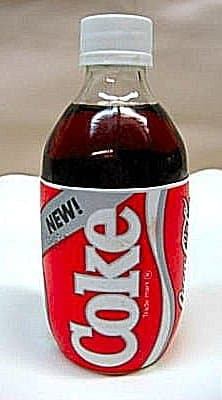
  30. Wikimedia Commons file pages for the two photographs: New Coke can.jpg and Newcokebottle2.jpg, both marked public domain.
  31. The Coca-Cola Company, Form 8-K, Exhibit 99.1 (second-quarter 2019 earnings release), filed Jul 23, 2019.
Data notes (8)

Data notes

Derived: 31,600 ÷ 400 = 79 and 31,600 ÷ 2 = 15,800 calls a day.1 200M aware − 110M tried = 90M.5 “At most 41%” is 100 − 59 from the Shapiro survey.6 The rise of about 54% in the share price is $115 ÷ $74.75.9 The 79 days are Coca-Cola’s own count from April 23 to July 11.1

Mixed series: The card sparkline and the share arc (0, 21.7, 3, 0.1, 0) combine a Beverage Digest figure for the old formula’s share quoted by UPI6, two figures from a 1999 secondary account16, and zeros as plotting conventions. It is an illustration of scale, not a measured series.

Unverified: The 3% and 0.1% shares for the 1985 formula come from Snopes, which cites books we did not read.16 The 50,000 cans of the 2019 run are Mother Jones’s figure; Coca-Cola’s page gives none, and other counts circulate that we could not trace.2527 Goizueta’s “the surest move ever made” is quoted from a 2015 history, not from a 1985 report we opened.23 That Coke II was used more widely from 1992 rests on two later summaries.2122

Conflicts between sources: The end of the product is 2002 in Mental Floss and The Henry Ford and 2004 in the Associated Press.192122 The reversal was announced on July 10 according to UPI and Time, with the press conference on July 11; UPI’s July 24 report says July 9.67818 The pre-launch tests covered “nearly 200,000” people in the company’s history and “over 190,000” in its spokesman’s words in 1985.14 The duration of the testing is three years in Time and four in a 2018 Washington Post summary.824 Coke’s 1984 share is 21.7% in UPI and 21.8% in a later Time article citing The New York Times; Dyson said “about 23 percent.”5623 Peak daily calls are 1,500 in the company’s account and in UPI, and “as many as 8,000” in one later history.1523 The Henry Ford dates the Coke II name to 1992; the Washington Post and Lewiston Tribune show it on test in 1990.121322

Unknown: Sales of the 1985 formula in any year. The cost of the reformulation, launch and reversal. The results of the Spokane test and the list of markets that later carried Coke II. The exact date the last Coke II was made. How many cans were produced in 2019.

How we read the sources: The UPI and Time articles could not be opened as raw pages; we read them through a text-extraction tool. For four UPI articles it returned the full text4569 and for the rest a list of the sentences with figures and quotations or a summary78111423, so those figures and quotations should be checked against the linked pages before being reused. The Washington Post archive pages show only their opening paragraphs without a subscription, and we cite them only for what those paragraphs say.2312 We could not open The New York Times’s 1985 coverage and do not cite it. The Keough quotation is taken from Snopes’s transcription.16

Images: The two photographs are from Wikimedia Commons, marked public domain by their uploaders, and are undated.30 The Internet Archive was rate-limiting requests while this page was built, so no archived web captures are shown. The accent red and the colours of the drawings were matched by eye to those photographs.

General knowledge: That The Coca-Cola Company is based in Atlanta and PepsiCo in Purchase, New York, and that “Stranger Things” is a Netflix series.