Spectre Brands

GhostRoadside restaurants · Quincy, Massachusetts

Howard Johnson’s

Soda fountain bought in 1925. Last restaurant closed in 2022.

The roof was orange so that drivers could see it from a distance. By the end there was one left to see.

Why ghost: The last Howard Johnson’s restaurant, in Lake George, New York, closed in 2022, but the name still hangs on 304 hotels franchised by Wyndham Hotels & Resorts.1416

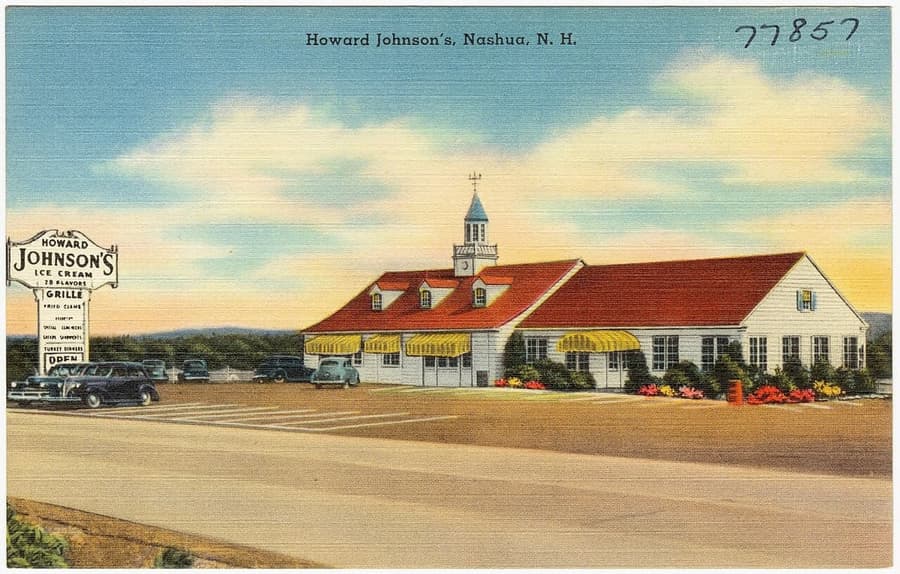
Linen postcard of a white Howard Johnson’s restaurant with an orange roof and cupola
Nashua, N.H., postcard, c. 1930–1945Tichnor Brothers, publisher; Boston Public Library collection, via Wikimedia Commons. Public domain.
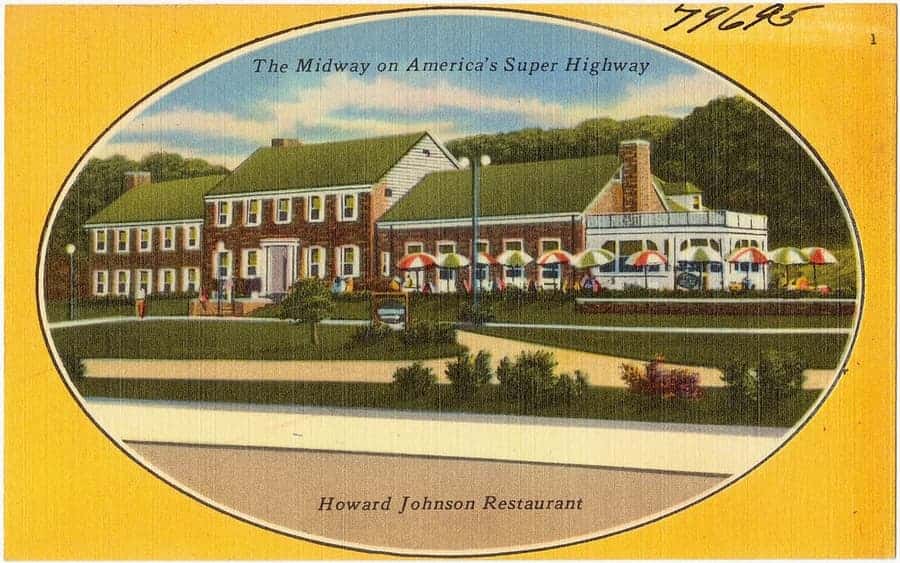
Linen postcard of the stone Midway service plaza on the Pennsylvania Turnpike
Pennsylvania Turnpike, c. 1940–1945Published by Howard Johnson Publishing Department, Bedford, Pa.; printed by Tichnor Bros., via Wikimedia Commons. Public domain.
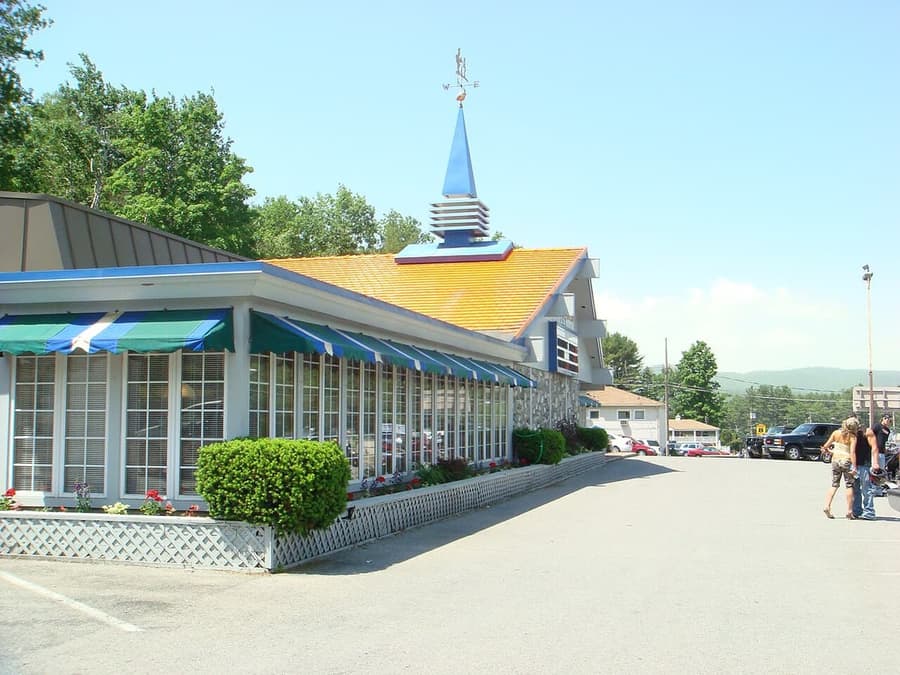
The Lake George Howard Johnson’s restaurant in 2007
Lake George, N.Y., 2007Photo: Jennifer Rafieyan, via Wikimedia Commons, CC BY 2.0.

Howard Johnson’s taught America to eat the same meal in every state. It had 1,040 restaurants when a British tobacco group paid $630 million for it, announced in 1979. Six years later it was sold again for half that and cut in two: the restaurants one way, the name and the hotels another. The last restaurant closed in Lake George, New York, in 2022. Most of this story predates electronic filings, so it is built from contemporary press, a reference history and later reporting, and it says where those sources disagree.

The chain in four numbers

1,040
restaurants when Imperial Group agreed to buy the company in 1979, about 75% of them company-owned1
$630M
paid by Imperial Group, at $28 a share1
$314M
paid by Marriott six years later for the company without Ground Round12
304
hotels still carrying the Howard Johnson name at the end of 202516

Key findings

  1. It stopped building in 1974 and never restarted. Howard B. Johnson froze expansion after the oil embargo and later told Forbes he had overreacted. The company sat on $90M of cash and securities while fast-food and lodging rivals built.1
  2. The restaurants were the weak half. Howard Johnson’s restaurants produced 78% of the restaurant group’s sales in 1977 but 57% of its pretax profit. The motels produced 16% of company sales in 1978 and more than 43% of earnings.1
  3. Two sales in six years halved the price. Imperial paid $630M and sold for $314M. Pretax earnings fell from $34M in 1979 to $14.7M in 1980 and did not fully recover.12
  4. The 1985 deal separated the name from the kitchens. Marriott kept 418 company restaurants to convert to other brands. Prime Motor Inns took the trademark, the hotels and 199 franchised restaurants it did not want.24
  5. The franchisees kept it alive for 37 more years. Their company, Franchise Associates, held a perpetual license from 1986. There were about 110 franchised restaurants in 1991, eight in 2005, three in 2007 and one from 2016 to 2022.16711

The story

Twenty-eight flavors, one orange roof and two bad sales

Howard Johnson’s did not go bankrupt. It was sold, split and converted, and what was left was licensed to its own franchisees, who ran out of restaurants one at a time.

Chapter 1 of 6

107

restaurants by the end of 1939, mostly along highways on the eastern seaboard

Postcard of a white colonial-style restaurant with an orange roof, a cupola and a roadside sign
Howard Johnson’s in Nashua, New Hampshire, on a Tichnor Brothers linen postcard dated by the Boston Public Library to about 1930–1945. Public domain.27

1925 – 1939 · Ice cream

A soda fountain, then a franchise

In 1925 Howard Deering Johnson borrowed $500 to buy a store in the Wollaston section of Quincy, Massachusetts, that sold candy, newspapers and patent medicines, and took on its debts with it. He revived the soda fountain with an ice cream that had almost twice the usual butterfat. By 1928 he was selling $240,000 of ice cream a year.1

His first restaurant opened in Quincy in 1929. He had no capital to open more, so in 1935 he persuaded an acquaintance to build one in Orleans, on Cape Cod, and sell his food under his name. The licensee paid for the building; Johnson collected a fee and sold the supplies.122 By the end of 1939 there were 107 Howard Johnson’s, with gross receipts of $10.5M.1

Chapter 2 of 6

12

restaurants still open in the summer of 1944, down from about 200

Postcard of a stone colonial building with umbrellas on a terrace, captioned The Midway on America’s Super Highway
The Midway plaza on the Pennsylvania Turnpike, on a postcard published by Howard Johnson’s own publishing department in Bedford, Pa., about 1940–1945. The turnpike restaurants were built of stone, without the orange roof. Public domain.27

1940 – 1954 · The road

The turnpike contract and the war

In 1940 the company won the contract for 24 restaurants on the new Pennsylvania Turnpike, and held that monopoly until 1979.1 The buildings were recognisable from a distance: orange porcelain roof tiles and a blue cupola, with the same 28 flavors of ice cream inside.1

Then gasoline was rationed. In little more than a year the chain fell from about 200 restaurants to about 75, and by the summer of 1944 only 12 were open. The company survived by running cafeterias for war plants. After the war it built smaller units, and by 1954 there were about 400 restaurants in 32 states. That year it entered the motel business.1

Chapter 3 of 6

605

Howard Johnson’s restaurants at the 1961 public offering: 265 company-run, 340 licensed

Commercial · 1962Howard Johnson’s television commercial A 29-second spot selling the orange roof and the 28 flavors to families on the road. The year 1962 comes only from the uploader.31 Watch on YouTube

1959 – 1975 · The peak

French chefs, a public company and 929 restaurants

The founder handed the presidency to his son, Howard Brennan Johnson, in 1959. The son was 26.1 Around 1960 the company hired Pierre Franey and Jacques Pépin from Le Pavillon in New York to run its commissary cooking.1319 Pépin later recalled that in the mid-1960s McDonald’s, Burger King and Kentucky Fried Chicken together were smaller than Howard Johnson’s.19

The company went public in 1961 with 605 restaurants and 88 franchised motor lodges. Under the son it bought back the profitable units: by 1963 company-owned restaurants outnumbered franchised ones. At the end of 1975 there were 929 Howard Johnson’s restaurants, 649 of them company-operated, and 536 motor lodges.1

Chapter 4 of 6

$630M

paid by Imperial Group, announced September 1979, at $28 a share

Original illustration: a highway exit sign in the brand’s colours. Not an official asset.

1974 – 1985 · The stall

Stand pat, then sell

Highway locations produced 85% of the business, and the 1974 oil embargo hit them directly. Johnson stopped expanding. Customers complained of slow service and bland, frozen food. Fast-food chains and newer motel chains kept building.1

In September 1979 Johnson accepted $630M from Imperial Group, a British tobacco, food and brewing conglomerate, for 1,040 restaurants and 520 motor lodges. Pretax earnings fell from $34M in 1979 to $14.7M in 1980.1 Franchisees later said Imperial spent $250,000 on restaurant services in four years.4 In September 1985 Imperial sold the company, without the Ground Round chain, to Marriott for $314M.2

I overreacted. I stopped all expansion, and once you stop, you know how hard it is to get the monster going again.

Howard B. Johnson to Forbes, 1978, as quoted in the International Directory of Company Histories1

Chapter 5 of 6

199

franchised restaurants passed to Prime Motor Inns in 1985, a hotel company that did not want them

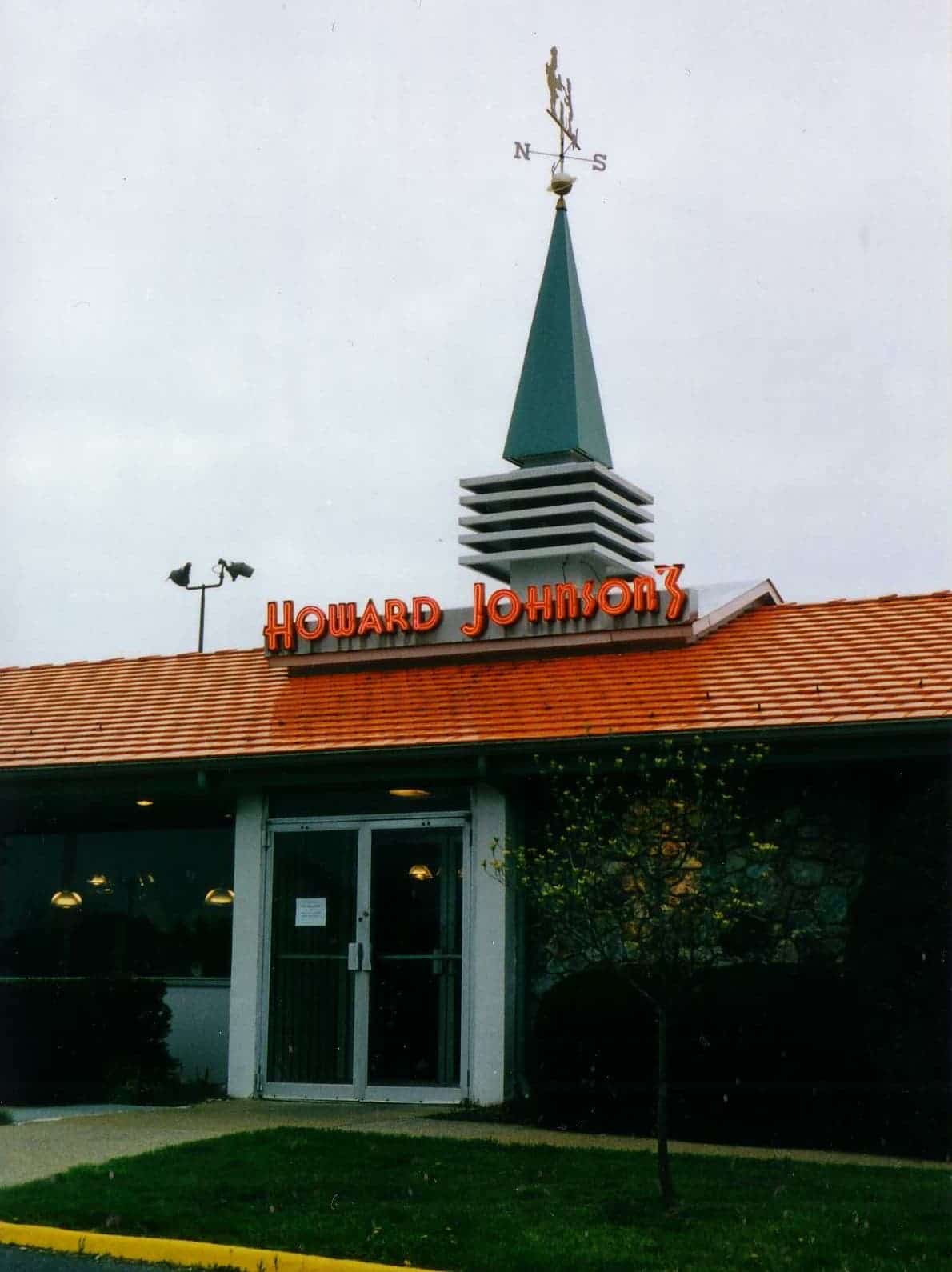
Entrance of a Howard Johnson’s restaurant with an orange roof and a teal spire, photographed in 1999
The entrance of a Howard Johnson’s restaurant in Pennsylvania in 1999, with the later teal spire. Photo: Christopher Ziemnowicz, public domain.27

1985 – 2005 · The orphans

The name goes one way, the kitchens another

Marriott kept 350 company restaurants and 68 turnpike restaurants, and said many would become Big Boy outlets. It sold the trademark, the hotels and the 199 franchised restaurants to Prime Motor Inns for $235M.2 By the end of 1987 Marriott still owned 90 Howard Johnson’s restaurants, and by mid-1991 only 50.1

The franchisees threatened to sue, and settled. On May 22, 1986 they incorporated Franchise Associates Inc., which received an exclusive license to the restaurant name.5 In 1991 there were about 110 franchised restaurants.1 By May 2005 there were eight, and the Associated Press could not get Franchise Associates to return its calls.6

Chapter 6 of 6

1

Howard Johnson’s restaurant left in the country after September 6, 2016

News segment · 2022WNYT: “Last Howard Johnson’s restaurant in America closes” Published June 2, 2022 by the Albany NBC affiliate: the local report on the closing of the Lake George restaurant.15 Watch on YouTube

2005 – 2022 · The last ones

Lake Placid, Bangor, Lake George

The Times Square restaurant, open since 1959, closed in 2005.2324 In 2007 the Waterbury, Connecticut restaurant left the system, which by then was run by a New York company called La Mancha Group. That left three.7

Lake Placid, open since April 1956, closed at the end of March 2015.9 Bangor, open since 1966, served its last meal on September 6, 2016.1011 Lake George, built in 1953, had closed in 2011 and reopened under a former employee in January 2015.13 It shut for good in the spring of 2022, and the property was put up for lease.1415

Timeline

Ninety-seven years, 31 moments

From the Wollaston soda fountain to the lease sign in Lake George. Filter by thread. Where only the year is known, only the year is given.

All 31 events as a list
  1. 1925
    Growth

    The Wollaston store

    Howard Deering Johnson buys a small store in Quincy’s Wollaston neighbourhood for $500 of borrowed money and takes on its debts. He rebuilds the soda fountain around a high-butterfat ice cream.1

  2. 1928
    Money

    $240,000 of ice cream

    Gross ice cream sales reach $240,000 a year.1

  3. 1929
    Growth

    First restaurant

    Opens in Quincy, with fried clams and broiled swordfish as specialties. The Associated Press dates the first restaurant a year earlier.16

  4. 1935
    Growth

    First franchise

    A restaurant in Orleans, on Cape Cod, sells Johnson’s food under his name. The operator pays for the building.122

  5. 1936
    Growth

    Out of Massachusetts

    The first location outside the state opens in Milford, Connecticut.10

  6. 1939
    Growth

    107 restaurants

    Gross receipts are $10.5M and profit is $207,000.1

  7. 1940
    Growth

    The Pennsylvania Turnpike

    The company wins the contract for 24 restaurants on the new turnpike. It keeps the monopoly until 1979.1

  8. Summer1944
    Decline & closings

    Twelve left

    Gasoline rationing cuts the chain from about 200 restaurants to 12. The company runs war-plant cafeterias to survive.1

  9. 1953
    Growth

    Lake George opens

    Carl DeSantis opens a franchised restaurant on Route 9 in Lake George, New York. It will be the last one.813

  10. 1954
    Growth

    About 400 restaurants, and the first motor lodge

    The chain is in 32 states. About 10% of units are company-owned turnpike sites. The company enters the motel business.1

  11. Apr1956
    Growth

    Lake Placid opens

    The restaurant that Ron Butler would later own opens in Lake Placid, New York.9

  12. 1959
    Corporate

    The son takes over

    Howard Brennan Johnson, 26, becomes president. A restaurant opens in Times Square at Broadway and 46th Street.123

  13. 1960
    Food

    Franey and Pépin

    The company hires Pierre Franey and Jacques Pépin from Le Pavillon to oversee its commissary cooking. Pépin dates his own arrival to the spring of 1960.1319

  14. 1961
    Money

    Goes public

    Howard Johnson Co. lists with 605 restaurants, 10 Red Coach Grills and 88 franchised motor lodges. 1960 net sales were $95M.1

  15. 1963
    Corporate

    Company-owned outnumber franchised

    For the first time the company runs more Howard Johnson’s than its licensees do.1

  16. 1966
    Growth

    Bangor opens

    A restaurant and lounge opens beside the motor lodge on Odlin Road in Bangor, Maine.10

  17. 1969
    Corporate

    Ground Round

    The company starts a pub-style suburban chain.1

  18. 1972
    Corporate

    The founder dies

    Howard Deering Johnson dies. He had stayed on as chairman and treasurer until 1964.1

  19. 1974
    Decline & closings

    Expansion stops

    After the oil embargo, Howard B. Johnson halts new building. Highway sites produce 85% of the business.1

  20. Dec1975
    Growth

    929 restaurants

    649 are company-operated. There are also 536 motor lodges, 32 Red Coach Grills and 63 Ground Rounds.1

  21. Sep1979
    Money

    Imperial Group bids $630M

    The British conglomerate offers $28 a share for 1,040 restaurants and 520 motor lodges. Howard B. Johnson collects $35.2M for his shares. Imperial owns the company from 1980.12

  22. 1981
    Corporate

    Johnson leaves

    Howard B. Johnson resigns as chairman, president and chief executive at the end of the year. G. Michael Hostage, a Marriott veteran, succeeds him.1

  23. Sep 241985
    Money

    Sold to Marriott and split

    Marriott buys the company for $314M, keeps 418 company restaurants and sells the name, the lodges and 199 franchised restaurants to Prime Motor Inns for $235M. Imperial keeps Ground Round.23

  24. May 221986
    Corporate

    Franchise Associates Inc.

    The restaurant franchisees incorporate their own company and receive an exclusive license to the Howard Johnson’s name for restaurants and signature foods.51

  25. 1990
    Money

    Prime sells the hotel brand

    Prime Motor Inns sells the Howard Johnson and Ramada franchise systems to an affiliate of Blackstone, and files for Chapter 11 in September.126

  26. 1991
    Decline & closings

    About 160 left

    About 110 franchised restaurants remain, and Marriott has 50. Franchise Associates buys 17 of Marriott’s.1

  27. 2005
    Decline & closings

    Eight left; Times Square closes

    The Associated Press counts eight restaurants in May. The Times Square restaurant closes that year.624

  28. Apr2007
    Decline & closings

    Three left

    Waterbury, Connecticut leaves the system. Lake George, Bangor and Lake Placid remain.7

  29. Mar 312015
    Decline & closings

    Lake Placid closes

    The Butler family sells the property to local restaurant owners after nearly 59 years.9

  30. Sep 62016
    Decline & closings

    Bangor closes

    The restaurant closes; the motel beside it stays open. One Howard Johnson’s restaurant is left.1011

  31. Spring2022
    Decline & closings

    Lake George closes

    The last restaurant shuts and the property is offered for lease. The exact last day of service is not reported.1415

The map

Where it began and where it ended

The chain reached 42 states at its height.1 We could not source a full list of locations, so this map shows only eight places we can document: where it started, how it first spread, and the last restaurants to close. All eight are in the Northeast.

Howard Johnson’s: first and last locations, 1925–2022

What this map shows: the origin in Quincy, the first franchise and the first turnpike contract, and the five last or best-known restaurants. Step through the timeline: sites appear when they opened and gray out when they closed.

Origin and early growthTurnpike and city landmarksThe last three restaurantsClosed by the selected date
All 8 places as a list
  1. Quincy (Wollaston), Massachusetts 1925
    The store Howard D. Johnson bought in 1925, and the first restaurant in 1929. Company headquarters stayed in Quincy.12
  2. Orleans, Cape Cod 1935
    The first franchised restaurant, 1935. Its closing date is not in our sources.122
  3. Milford, Connecticut 1936
    The first location outside Massachusetts, 1936. Its closing date is not in our sources.10
  4. Pennsylvania Turnpike, Midway plaza (Bedford) 1940 – 1979 (contract)
    One of 24 turnpike restaurants under the 1940 contract. The monopoly lasted until 1979.127
  5. Times Square, New York 1959 – 2005
    Broadway at 46th Street. Opened 1959, closed 2005.2324
  6. Lake George, New York 1953 – 2022
    Built 1953. Closed 2011, reopened January 2015, closed for good in spring 2022. The last one.81314
  7. Lake Placid, New York Apr 1956 – Mar 2015
    Opened April 1956. Closed March 31, 2015.9
  8. Bangor, Maine 1966 – Sep 2016
    Opened 1966 beside the motor lodge on Odlin Road. Closed September 6, 2016.1011
Pins are placed at town level and nudged apart so they don’t overlap; a thin line joins a moved pin to its true location. Opening and closing dates known only to the year are placed on January 1 or mid-year for the animation; the text gives the precision the source gives. Base map: U.S. Census Bureau via us-atlas30.

Not shown: the roughly 1,000 other restaurants. We found no complete, dated location list in a source we could verify, and we did not want to plot pins from enthusiast sites we could not check.

Restaurant entrance with an orange roof and teal spire
1999 Entrance to a full-service Howard Johnson’s restaurant in Pennsylvania.Photo: Christopher Ziemnowicz (CZmarlin), via Wikimedia Commons. Public domain.

Part 2 of 6

Business

The numbers · Rivals

The record

How many restaurants, who owned them, and what they sold for

The company was private until 1961 and foreign-owned after 1980, so there is no run of annual filings to chart. What exists is a set of dated counts and prices from a reference history and the press of the time. Every point below is one of those; nothing is interpolated.

The orange roofs, counted

Howard Johnson’s restaurants open at each date for which a sourced count exists. The dates are not evenly spaced.

05001,0001,50019391944196119791991200720221234505001,0001,5001939195419792005202212345
  1. 1944 · rationing Gasoline rationing closes all but 12 restaurants by the summer of 1944.1
  2. 1961 · the listing 605 restaurants at the 1961 public offering, 265 of them company-run.1
  3. 1979 · the peak, and the sale 1,040 restaurants pass to Imperial Group for $630M.1
  4. 1985 · the split Marriott takes 418 company restaurants to convert; 199 franchised ones go to Prime Motor Inns.2
  5. 2016 · one left Bangor closes on September 6, 2016. Only Lake George remains, until 2022.1114

Other sources put the peak lower: “about 850” (a chain historian quoted by the AP6) and “nearly 900” (Hartford Courant7). Later press usually says “about 1,000” or “more than 1,000”.1425

Data table
The orange roofs, counted
Year of countRestaurants
1939107
c. 1941200
194412
1954400
1961605
1975929
19791,040
1985617
1991160
20058
20073
20161
20220
Counts for 1939–1991 from the International Directory of Company Histories1; 1985 from the Los Angeles Times2; 2005 from the Associated Press6; 2007 from the Hartford Courant7; 2016 and 2022 from Maine Public and CNN1114. The 1985 figure (617) is derived: 350 + 68 + 199. The 1991 figure (160) is derived: about 110 franchised plus 50 owned by Marriott in mid-1991. “c. 1941” and 1954 are the source’s round figures (“about 200”, “about 400”).

Who ran the restaurants

Company-operated against franchised Howard Johnson’s restaurants at four dates.

Data table
Who ran the restaurants
PeriodCompany-operatedFranchised
1961265340
1975649280
1979780260
1985418199
1961, 1975 and 1979 from the International Directory of Company Histories1; 1985 from the Los Angeles Times2. Derived: 1975 franchised = 929 − 649 = 280. The 1979 split applies the source’s “75 percent company-owned” to 1,040 restaurants (780 and 260), so it is approximate.

What the company fetched

Reported prices each time the business, or a piece of it, changed hands, in $ millions. Not adjusted for inflation.

Data table
What the company fetched
PeriodReported price
1979–80: whole company to Imperial Group$630M
1985: company less Ground Round to Marriott$314M
1985: name, lodges, franchises Marriott to Prime$235M
1990: HoJo + Ramada systems Prime to Blackstone$170M
1979 and 1990 from the International Directory of Company Histories1; 1985 from the Los Angeles Times2. UPI and the Orlando Sentinel give the 1985 price as $300M, and the Sentinel gives the 1979–80 price as $650M.34 The $235M is $97M in cash plus $138M of assumed debt.1 A history of Prime gives the 1990 deal as $140M for 65% of the two franchise systems.26

Where 617 restaurants went in September 1985

The Marriott deal divided the chain by who owned the building.

617 Howard Johnson’s restaurants at the sale (derived)
350 57%Company-owned, kept by Marriott68 11%Turnpike restaurants, kept by Marriott199 32%Franchised, passed to Prime Motor Inns350 57%Company-owned, kept by Marriott68 11%Turnpike restaurants, kept byMarriott199 32%Franchised, passed to Prime MotorInns
  • Company-owned, kept by Marriott. Many were to be converted to Big Boy.2
  • Turnpike restaurants, kept by Marriott. Added to Marriott’s 40 turnpike sites.2
  • Franchised, passed to Prime Motor Inns. Licensed to the franchisees’ own company in 1986.5
Data table
Where 617 restaurants went in September 1985
Where it wentAmountShareNote
Company-owned, kept by Marriott35057%Many were to be converted to Big Boy.
Turnpike restaurants, kept by Marriott6811%Added to Marriott’s 40 turnpike sites.
Franchised, passed to Prime Motor Inns19932%Licensed to the franchisees’ own company in 1986.
Los Angeles Times, September 25, 19852. The total of 617 is derived: 350 + 68 + 199.
The balance between restaurants and motels before the sale
78%of the restaurant group’s 1977 sales came from Howard Johnson’s restaurants, but only 57% of its pretax profit1
43%or more of 1978 earnings came from the motels, on 16% of company sales1
$90Min cash and marketable securities in the late 1970s, with no long-term debt apart from $143M of capital leases1
−57%fall in pretax earnings from $34M (1979) to $14.7M (1980), the first year under Imperial (derived)1
International Directory of Company Histories, vol. 721. Derived: (14.7 − 34) ÷ 34 = −57%.

For each Howard Johnson’s at the peak, McDonald’s now has about 44

45,356McDonald’s restaurants worldwide, end of 2025
=
44 ×Howard Johnson’s restaurants, 1979 (1,040)

Derived 45,356 ÷ 1,040 = 43.6, shown as 44 icons. McDonald’s 2025 Form 10-K17; Howard Johnson’s count from the International Directory of Company Histories1.

Data table
For each Howard Johnson’s at the peak, McDonald’s now has about 44
Value
McDonald’s restaurants worldwide, end of 202545,356
Howard Johnson’s restaurants, 19791,040
Ratio44 (derived)
McDonald’s Corporation Form 10-K for 202517 and the International Directory of Company Histories1. The comparison is across 46 years and between a worldwide and a mostly U.S. chain.

The rivals

The chains that took the highway

Howard Johnson’s was a sit-down restaurant with a long menu. The chains that replaced it at the exit ramp sold fewer things faster, or sold the same thing for longer hours. Only figures we could source are shown; for most rivals that means their latest annual report.

Who is still open

Restaurant or hotel counts at the dates shown.

Howard Johnson’s restaurants

Last one closed 2022
19392022
0 1,040 in 1979, 617 at the 1985 sale, 8 in 2005, none since 2022.12614

McDonald’s

Survived
20232025
45,356 Restaurants worldwide at the end of 2025, about 95% franchised. 13,706 are in the United States.17

Denny’s

Survived
1,499 Denny’s-brand restaurants at December 25, 2024, of which 1,334 are in the United States. The closest surviving format: a full-service chain near the highway.18

Ground Round

Kept by Imperial, 1985
210 Units in 1985. Started by Howard Johnson Co. in 1969 and regarded as one of its more profitable operations.12

Howard Johnson hotels

Wyndham brand
19952025
304 Properties at the end of 2025, down from 523 at the end of 1995.161
Data table
Who is still open
CompanyOutcomeLocationsNotesSeries
Howard Johnson’s restaurantsLast one closed 202201,040 in 1979, 617 at the 1985 sale, 8 in 2005, none since 2022.107, 400, 605, 929, 1040, 617, 160, 8, 1, 0
McDonald’sSurvived45,356Restaurants worldwide at the end of 2025, about 95% franchised. 13,706 are in the United States.41822, 43477, 45356
Denny’sSurvived1,499Denny’s-brand restaurants at December 25, 2024, of which 1,334 are in the United States. The closest surviving format: a full-service chain near the highway.
Ground RoundKept by Imperial, 1985210Units in 1985. Started by Howard Johnson Co. in 1969 and regarded as one of its more profitable operations.
Howard Johnson hotelsWyndham brand304Properties at the end of 2025, down from 523 at the end of 1995.523, 464, 304
International Directory of Company Histories1; Los Angeles Times2; Associated Press6; CNN14; Form 10-K filings of Wyndham Hotels & Resorts, McDonald’s and Denny’s161718. The middle point of the hotel series (464) is the AP’s 2005 figure.6
Sold to Imperial

Howard Johnson’s, 1979

Restaurants
1,040
Company-owned
about 75%
Format
Table service, long menu
Food
Made in commissaries, frozen, shipped
Where
Highways: 85% of business
Still growing

McDonald’s, 2025

Restaurants
45,356
Company-owned
about 5%
Format
Counter and drive-through
Planned openings, 2026
about 2,600
Target
50,000 by end of 2027
Howard Johnson’s figures from the International Directory of Company Histories and Eater113; McDonald’s from its 2025 Form 10-K17. The two columns are 46 years apart and are not a like-for-like comparison.

What Marriott already owned when it bought the restaurants

Restaurant units by brand in September 1985. Marriott wanted the sites for its own chains.

Bob’s Big Boy (Marriott)
868
Roy Rogers (Marriott)
542
Howard Johnson’s company-owned restaurants
350
Howard Johnson’s franchised restaurants
199
Howard Johnson’s turnpike restaurants
68
Marriott turnpike restaurants
40
Data table
What Marriott already owned when it bought the restaurants
ChainUnitsNote
Bob’s Big Boy (Marriott)868
Roy Rogers (Marriott)542
Howard Johnson’s company-owned restaurants350
Howard Johnson’s franchised restaurants199
Howard Johnson’s turnpike restaurants68
Marriott turnpike restaurants40
Los Angeles Times, September 25, 19852.

It is the restaurants where the majority of the image damage has been done.

John J. Rohs, analyst at Wertheim & Co., to the Los Angeles Times, September 19852

We found no reliable year-by-year restaurant counts for McDonald’s, Burger King or Kentucky Fried Chicken in the 1960s and 1970s in sources we could open, so no historical comparison is charted. Jacques Pépin’s recollection that the three together were smaller than Howard Johnson’s in the mid-1960s is his own statement, not a measured figure.19

Part 3 of 6

Brand

Commercials & footage · Brand gallery

Commercials & footage

The roof on television

Two commercials from the years when the chain was growing, and four pieces of reporting from the years when it was down to its last restaurants.

Commercial · 1962Howard Johnson’s television commercial A 29-second spot selling the orange roof and the 28 flavors to families on the road. The year 1962 comes only from the uploader.31 Watch on YouTube
Commercial · 1970Animated commercial for children’s parties An animated one-minute ad inviting children to hold their parties at the restaurant. The year 1970 comes only from the uploader, a commercial-archive channel.31 Watch on YouTube
News segment · 2015CBS Sunday Morning: “The last Howard Johnson’s restaurant” Published July 12, 2015. Kristine Johnson visits Lake George, a few months after it reopened and after Lake Placid closed. Bangor was still open at the time.28 Watch on YouTube
News segment · 2017BBC News: “The last Howard Johnson’s” Published August 31, 2017. A BBC reporter who shares the founder’s name visits the Lake George restaurant and asks what went wrong.29 Watch on YouTube
News segment · 2022WNYT: “Last Howard Johnson’s restaurant in America closes” Published June 2, 2022 by the Albany NBC affiliate: the local report on the closing of the Lake George restaurant.15 Watch on YouTube
Interview · 2021A history of Howard Johnson’s, with Anthony Sammarco Published June 1, 2021. An hour-long podcast interview with the Boston historian who wrote a book-length history of the chain. Useful background; we did not use it as a source for figures. Watch on YouTube

Videos are embedded from the services that host them and load only when you press play. YouTube embeds use youtube-nocookie.com. Each video belongs to its uploader or rights holder and is shown here for commentary; we do not host any of the files. Upload titles and dates on video platforms are often wrong. The two commercials are dated by their uploaders only.

Part 4 of 6

People

People · Press

The people

Who built it, who sold it, who closed it

Roles and dates are from the sources cited. Later careers are given only where a source covers them.

People (8)
Name and roleWhat they didAfterwards
Howard Deering JohnsonFounder; sole owner until 1961

A grammar-school education and a failed family cigar business behind him, he bought the Wollaston store in 1925. He pioneered restaurant franchising because banks would not lend to him. Chairman and treasurer until 1964.1

Died in 1972.1
Howard Brennan JohnsonPresident from 1959; chairman and CEO until the end of 1981

Took over at 26, after Andover, Yale and Harvard Business School. Shifted the chain toward company-owned units, then froze expansion in 1974. Received $35.2M for his shares in the Imperial sale.1

Pierre FraneyVice president for menu development, from about 1960

Executive chef of Le Pavillon in New York before the founder hired him.1920

Later a food columnist for The New York Times.20
Jacques PépinCommissary chef, from 1960

Says he chose Howard Johnson’s over a job at the Kennedy White House. He began on the line at a Howard Johnson’s in Queens before moving to the commissary, where he and Franey worked for nearly a decade.192113

Became a television cook and author.19
G. Michael HostagePresident and CEO under Imperial, from 1982

A fifteen-year Marriott veteran. Tried to integrate adjacent restaurants and lodges and let managers buy food from outside suppliers.12

George CarterChairman, Franchise Associates Inc.

A second-generation franchisee who led the operators’ company formed after the 1985 breakup. In 1987 he said the chain needed to be modernized inside and out.4

Carl and Joe DeSantisOwners, Lake George

Carl DeSantis opened the Lake George restaurant in 1953 and handed the family company to his son Joe in 1995. Joe closed it in 2011 and later leased it to a former employee, who reopened it in January 2015.13

Ron ButlerOwner, Lake Placid

Came to manage the Lake Placid restaurant when it opened in April 1956, bought it a few years later and ran it with his sons until March 2015.9

The clippings

What they said at the time

Press (7)
I overreacted. I stopped all expansion, and once you stop, you know how hard it is to get the monster going again.
Howard B. Johnson, to Forbes, 1978, as quoted in the International Directory of Company Histories1
  1. Howard B. Johnson, on becoming president at 26, as quoted in the same history1

    My father felt that I should start at the top and work my way down.
  2. A gag of the 1970s, as recorded in the International Directory of Company Histories1

    Howard Johnson’s ice cream comes in 28 flavors and its food in one.
  3. Melvin Taub, executive vice president of Prime Motor Inns, on the franchised restaurants, Orlando Sentinel, April 19874

    We were more anxious to get rid of them than they were to get them.
  4. George Carter, chairman of Franchise Associates, Orlando Sentinel, April 19874

    Howard Johnson was allowed to become tired and stale.
  5. Walter Mann, who ran a fan website about the chain, to the Associated Press, May 20056

    It’s definitely twilight time for Howard Johnson’s.
  6. Sally Patel, co-owner of the Bangor restaurant, to the Associated Press, August 201612

    It’s not worth it to keep it open. We tried for four years.
Postcard of a stone turnpike service plaza
c. 1940–1945 “The Midway on America’s Super Highway”: the Howard Johnson restaurant at the Midway plaza of the Pennsylvania Turnpike.Published by Howard Johnson Publishing Department, Bedford, Pa.; printed by Tichnor Bros., via Wikimedia Commons. Public domain.

Part 5 of 6

Verdict

Cause of death · What if · Afterlife

Cause of death

The autopsy

Tap a cause to see the evidence. The percentages are our editorial weighting. The evidence under each one is sourced.

Cause of death, by editorial weight

One square is one percentage point. The weights are our judgment, not a measurement.

  1. 30%Management that stood pat
  2. 25%Fast food did the same job faster
  3. 20%The 1985 breakup
  4. 15%Dependence on the highway
  5. 10%A franchisee co-operative without capital
Data table
Cause of death, by editorial weight
CauseWeight
Management that stood pat30%
Fast food did the same job faster25%
The 1985 breakup20%
Dependence on the highway15%
A franchisee co-operative without capital10%

Howard B. Johnson stopped all expansion after the 1974 oil embargo and later called it an overreaction. The company held $90M in cash and securities and carried no long-term debt beyond leases while rivals built. A former executive said the company had ideas to upgrade the restaurants and hotels but did not want to spend the money. The Hartford Courant summed up his tenure as cutting costs and raising prices.17

The reference history says the chain was falling behind McDonald’s and Burger King, and that customers complained of slow service and overpriced, bland, mostly frozen food. In 1985 analysts told the Los Angeles Times that the chain had failed to keep up with growing competition, and that the name itself might be a liability.12 McDonald’s had 45,356 restaurants at the end of 2025.17

Marriott bought the company for its sites, not its brand, and planned to convert the 350 company restaurants. The trademark went to a hotel company. Prime’s executive vice president said of the franchised restaurants that Prime was more anxious to be rid of them than the franchisees were to get them.24 After 1985 nobody who owned the name had a reason to invest in the restaurants.

Highway operations were 85% of the business in the 1970s. Rationing had already cut the chain to 12 restaurants in 1944; the 1974 embargo and later fuel price rises hit the same weakness.1 In Bangor the manager blamed nearby hotels that had started giving away breakfast.10

Franchise Associates collected 1.5% of franchisees’ gross revenue and planned to spend $1.4M on restaurant services in 1987–88. It owned the recipes and a license, not the trademark. By 2005 the Associated Press found its website out of date and its phone unanswered; by 2007 the rights were with La Mancha Group, which one franchisee said provided almost nothing.4567

Editorial judgment: the weights are an interpretive model by the Spectre Brands editors, not a measured quantity. The sources document what happened. How much each factor contributed is a judgment, and a reasonable reader could weigh fast-food competition above management.

The fork in the road

What if…

Three decisions where the story could have gone differently. The “What if” panels are speculation, labeled as such.

What happened

After the oil embargo Howard B. Johnson stopped all expansion. He told Forbes in 1978 that he had overreacted. The company ended the decade with $90M in cash and securities and restaurants that customers described as slow and dated.1

What if speculative

The cash could have paid for new formats in towns instead of on highways, which is what Johnson said new units would be. Ground Round, the one new format the company did build, reached 210 units by 1985 and was the part Imperial chose to keep.12 A renewed core chain might have been worth more than $314M in 1985. It would still have faced McDonald’s.

What happened

Johnson took $28 a share from Imperial Group, a tobacco company with no American restaurant business. Pretax earnings fell by more than half in the first year, and franchisees said Imperial spent $250,000 on restaurant services in four years.14

What if speculative

An independent company with no debt could have funded its own renovation. But the family had been selling shares since 1961, and the offer was described as too lucrative to pass up.1 The more plausible alternative is a different buyer, one that already ran restaurants.

What happened

Marriott kept the buildings and sold the name. The 199 franchised restaurants were left with a brand owned by a hotel company and no commissary behind them. They won a license in 1986 and shrank from about 110 in 1991 to eight in 2005.126

What if speculative

A buyer that wanted both the restaurants and the trademark would have had a reason to renovate them. Whether one existed is unknown: the Los Angeles Times reported up to four bidders but did not say what each wanted.2 Most family-restaurant chains of that generation have shrunk since, so the likelier outcome is a slower decline, not a rescue.

Where are they now

The afterlife

Howard Johnson’s

  1. The hotels

    Alive

    Howard Johnson is one of Wyndham Hotels & Resorts’ economy brands: 304 properties and 43,998 rooms at December 31, 2025, of which 133 are in the United States. More of the rooms are in Greater China (26,456) than in the U.S. (10,119).16

  2. The restaurant name

    Dormant

    Eater reported in 2017 that Wyndham owns all the relevant Howard Johnson’s trademarks, and that only a former franchisee reopening on an original site, or Wyndham itself, could put the name on a restaurant again.13 No restaurant uses it today.14

  3. The company-owned restaurants

    Converted

    Marriott kept 418 of them in 1985 and said many would become Big Boy outlets. It still owned 90 at the end of 1987 and 50 in mid-1991, when Franchise Associates bought 17.12

  4. The last building

    Closed

    The Lake George restaurant went up for lease in late 2021. CNN reported that the listing for the 7,500 square foot building stated a price of $10.14 What has happened to the building since is not covered by our sources.

  5. The recipes

    Licensed out

    Franchise Associates said in 2001 that it owned the original recipes and had licensed manufacturers to make the ice cream and other signature products for shops and grocery stores.5 Whether any of these are still made is unknown to us.

  6. Ground Round

    Spun off

    Imperial kept the 210-unit Ground Round chain out of the 1985 sale because Marriott did not want it.12 Its later history is outside this page.

Who owned the name

After 1985 the trademark and the restaurants had different owners.

  1. 1925

    Howard Deering Johnson

    Buys the Wollaston store and puts his name on the ice cream. Sole owner until the 1961 listing.1

  2. 1961

    Howard Johnson Co. (public)

    Listed with 605 restaurants. The family sells shares through the 1960s.1

  3. 1980

    Imperial Group

    The British tobacco and brewing group buys the whole company, agreed in September 1979.12

    $630M
  4. Sep 1985

    Marriott Corp.

    Buys the company without Ground Round, keeps 418 company restaurants for conversion and passes the name on at once.2

    $314M
  5. Sep 1985

    Prime Motor Inns

    Takes the trademark, 125 company lodges, 375 franchised lodges and 199 franchised restaurants.2

    $235M
  6. May 1986

    Franchise Associates Inc. (restaurant license)

    The franchisees’ own company gets an exclusive license for restaurants and signature foods. By 2007 the franchise rights are with La Mancha Group.57

  7. 1990

    Blackstone affiliate, later HFS and Cendant

    Prime sells the Howard Johnson and Ramada systems and files for Chapter 11 that September. Hospitality Franchise Systems becomes HFS, then Cendant in 1997.126

    $170M
  8. 2018

    Wyndham Hotels & Resorts

    Spun off from Wyndham Worldwide. Franchises 304 Howard Johnson hotels. No restaurants.16

Data table
Who owned the name
WhenOwnerWhat happenedPrice
1925Howard Deering JohnsonBuys the Wollaston store and puts his name on the ice cream. Sole owner until the 1961 listing.
1961Howard Johnson Co. (public)Listed with 605 restaurants. The family sells shares through the 1960s.
1980Imperial GroupThe British tobacco and brewing group buys the whole company, agreed in September 1979.$630M
Sep 1985Marriott Corp.Buys the company without Ground Round, keeps 418 company restaurants for conversion and passes the name on at once.$314M
Sep 1985Prime Motor InnsTakes the trademark, 125 company lodges, 375 franchised lodges and 199 franchised restaurants.$235M
May 1986Franchise Associates Inc. (restaurant license)The franchisees’ own company gets an exclusive license for restaurants and signature foods. By 2007 the franchise rights are with La Mancha Group.
1990Blackstone affiliate, later HFS and CendantPrime sells the Howard Johnson and Ramada systems and files for Chapter 11 that September. Hospitality Franchise Systems becomes HFS, then Cendant in 1997.$170M
2018Wyndham Hotels & ResortsSpun off from Wyndham Worldwide. Franchises 304 Howard Johnson hotels. No restaurants.
International Directory of Company Histories1, Los Angeles Times2, Franchise Associates5, Hartford Courant7, Wyndham’s 2025 Form 10-K16. The “bankrupt” marker on the 1990 step refers to the seller, Prime Motor Inns, not to the Howard Johnson brand.

Sources & data notes

Show your work

Howard Johnson Co. was listed from 1961 to 1980, before electronic filing, so there are no EDGAR documents for the restaurant company. The spine of this page is a reference history that cites the press of the time, checked against contemporary newspaper reports where we could open them. SEC filings are used for today’s hotel brand and for rivals.

  1. “Howard Johnson International, Inc.,” International Directory of Company Histories, vol. 72 (St. James Press, 2005), reproduced at FundingUniverse. A reference history that itself cites Fortune (1940), Business Week, Forbes (1978) and The New York Times (1979, 1982, 1985)
  2. Los Angeles Times: report on the sale of Howard Johnson Co. to Marriott and Prime Motor Inns, Sep 25, 1985
  3. United Press International: “Marriott to buy Howard Johnson”, Sep 24, 1985
  4. Orlando Sentinel: “Restaurant chain fights stale image: operators hope to end Howard Johnson slump”, Apr 30, 1987
  5. Franchise Associates, Inc.: “The Howard Johnson Story: A New Era, 1980–Present”, company website as archived Mar 2, 2001 (Internet Archive)
  6. Associated Press, via NBC News: report on the eight remaining Howard Johnson’s restaurants, May 15, 2005
  7. Hartford Courant: “Broken chain: state loses last HoJo’s”, Apr 15, 2007
  8. Times Union (Albany): “Restaurants served a slice of Americana”, Marv Cermak, Jul 9, 2012 (Internet Archive copy)
  9. NPR: “With nostalgia and a last nosh, 1 of 3 remaining HoJo’s closes”, Brian Mann, transcript, Apr 1, 2015
  10. Bangor Daily News: “Restaurant, lounge at Bangor Howard Johnson to close”, Dawn Gagnon, Aug 24, 2016
  11. Maine Public / Associated Press: “Bangor’s Howard Johnson restaurant closes Tuesday”, Sep 6, 2016
  12. Fortune / Time: “There will soon be just one Howard Johnson restaurant left in the U.S.”, Katie Reilly, Aug 24, 2016, quoting the Associated Press
  13. Eater: feature on the last Howard Johnson’s restaurant, Lake George, Feb 14, 2017
  14. CNN Business: report on the closing of the last Howard Johnson’s restaurant, Jordan Valinsky, Jun 1, 2022
  15. WNYT NewsChannel 13 (Albany): “Last iconic Howard Johnson’s restaurant closes in Lake George”, June 2022, and its video report, published Jun 2, 2022
  16. Wyndham Hotels & Resorts, Inc.: Form 10-K for 2025, filed Feb 19, 2026: brand portfolio table and “Our History”
  17. McDonald’s Corporation: Form 10-K for 2025, filed Feb 24, 2026: systemwide restaurants at year end
  18. Denny’s Corporation: Form 10-K for fiscal 2024, filed Feb 24, 2025
  19. KLCS Public Media: “Full exclusive interview with Jacques Pépin” (undated on the page)
  20. New England Historical Society: “Howard Johnson’s goes from one restaurant to 1,000 to zero”
  21. Mental Floss: history of the Howard Johnson’s restaurants
  22. CapeCod.com: “The history of Howard Johnson’s restaurant”
  23. The Real Deal: “1551 Broadway: the transformation from HoJo’s to American Eagle”, James Gardner, Mar 19, 2010
  24. The Bowery Boys: New York City History: post on the Times Square Howard Johnson’s
  25. Yankee / New England.com: “The last Howard Johnson’s restaurant in New England”, Aimee Tucker, visit in 2015, updated Jul 26, 2022
  26. “Prime Hospitality Corporation” company history, reproduced at company-histories.com
  27. Wikimedia Commons file pages for the four images used: Nashua postcard, Pennsylvania Turnpike Midway postcard, Pennsylvania entrance, 1999, Lake George, 2007
  28. CBS Sunday Morning: “The last Howard Johnson’s restaurant”, video, published Jul 12, 2015
  29. BBC News: “The last Howard Johnson’s (by Howard Johnson)”, video, published Aug 31, 2017
  30. Map data: U.S. Census Bureau cartographic boundary files and us-atlas (Census-derived TopoJSON). Rendered with d3-geo.
  31. YouTube uploads of two commercials: “Howard Johnson’s Commercial 1962” (uploaded Apr 8, 2022) and “1970 Howard Johnson’s Restaurant Commercial” (uploaded Mar 6, 2009). Dates of airing are the uploaders’
Data notes (9)

Data notes

Editorial: this page is about the restaurant chain. “Died 2022” is the year the last restaurant closed. The decline ran from the mid-1970s, the founding family sold in 1979–80, and corporate ownership of the restaurants ended in 1985, when Marriott took the company-owned units and the franchisees were left with a license. The hotel brand is a separate business and is alive.

Sources we could not open: The New York Times archive (its 1979, 1982 and 1985 articles on the company, and Jacques Pépin’s 2005 essay) was not reachable from our tools, so nothing here is cited to it directly. The reference history1 cites those articles. The UPI report3 was read through a fetch tool that returned a summary, so we use it only for its figures.

Ranges and disagreements: Peak size: 929 restaurants at the end of 1975 and 1,040 at the 1979 sale1; “about 850”6; “nearly 900”7; “about 1,000” or “more than 1,000” in later press1425. We use 1,040. 1979–80 price: $630M15 or $650M4. 1985 price: $314M12 or $300M34. First restaurant: 19291 or 1928 (the AP’s “three years later”)6. Hiring of Franey and Pépin: 19601319 or 195921. Founder’s death: 1972120; a former franchisee recalled 1975 on NPR9. Imperial’s offer was accepted in September 1979 and several sources date its ownership from 1980.

Derived: 617 restaurants at the 1985 sale = 350 + 68 + 1992. About 160 restaurants in 1991 = about 110 franchised + 50 Marriott-owned1. 1975 franchised restaurants = 929 − 649 = 2801. 1979 split of 780 and 260 = 75% and 25% of 1,0401, approximate. Fall in pretax earnings = (14.7 − 34) ÷ 34 = −57%1. McDonald’s multiple = 45,356 ÷ 1,040 = 43.6171. “Nearly 59 years” for Lake Placid = April 1956 to March 20159. “Ninety-seven years” = 1925 to 2022.

Estimates and round figures: “About 200” restaurants before rationing, “about 400” in 1954, “about 110” franchised in 1991 and “about 150” franchisees in the 1985–86 dispute are the reference history’s round numbers1. Jacques Pépin’s statement that three fast-food chains together were smaller than Howard Johnson’s in the mid-1960s is a recollection19.

Unverified or unknown: The exact last day of service in Lake George (reports say only that it closed in the weeks before June 1, 2022)14. The exact closing date of the Times Square restaurant in 2005; a widely repeated date of July 9 could not be confirmed in a source we opened. When and on what terms the restaurant rights moved from Franchise Associates to La Mancha Group, and from there to the hotel brand’s owner; Eater says only that Wyndham held the trademarks by 201713. Year-by-year sales and profit of the restaurants. A complete list of locations. The fate of the Lake George building after 2022.

Video dates: The two commercials are dated 1962 and 1970 by their uploaders only31. News videos are dated by their publication on the broadcaster’s channel.

Images: All four photographs and postcards are from Wikimedia Commons under the licenses stated in the gallery27. The postcards are dated by the Boston Public Library to about 1930–1945; the turnpike card cannot predate 1940. The drawings are original and are not official assets.

General knowledge: Town locations on the map; that Quincy is south of Boston; that Lake George and Lake Placid are in the Adirondacks.