Spectre Brands

GhostVideo rental superstores · Wilsonville, Oregon

Hollywood Video

First store opened Oct 1988. Liquidation of the last stores approved May 2010.

It got through the mistake it made itself. It did not get through the one its buyer made.

Why ghost: Movie Gallery, which bought the chain in 2005, closed every remaining Hollywood Video store in a liquidation approved in May 2010, but hollywoodvideo.com still publishes an entertainment blog under the name; we could not establish who owns it.192022

Original illustration of a video superstore with a zigzag roofline and red neon, in the spirit of the chain. Not an official asset; the sign lettering is deliberately blank.

Hollywood Entertainment grew from 25 video stores at the end of 1993 to 1,615 six years later, bought a web retailer at the top of the bubble, and by the end of 2000 its auditors doubted it could continue. It recovered, and by 2004 had 2,006 stores and three suitors. The winner, Movie Gallery, paid with borrowed money just as renters began to drift to the mailbox and the kiosk. This post-mortem is built from the two companies’ SEC filings and the wire reports of the 2010 liquidation.

The chain in four numbers

2,006
company-operated stores in 47 states and the District of Columbia at the end of 20045
$548.3M
net loss in 2000, as later restated, the year it closed Reel.com’s store and stopped building5
$1.25B
approximate value of the sale to Movie Gallery in April 2005, including assumed debt10
545
Hollywood Video stores left after the closures announced with the February 2010 bankruptcy17

Key findings

  1. It grew faster than it could pay for. Stores went from 25 at the end of 1993 to 1,615 at the end of 1999, and long-term obligations from $8.0M in 1995 to $533.9M in 1999.12
  2. Its dot-com bet lasted 20 months. Hollywood bought Reel.com for about $96.9M on October 1, 1998 and closed its e-commerce business on June 12, 2000, with a $69.3M charge.3
  3. It recovered before it was sold. After a restated net loss of $548.3M in 2000, the company reported four straight profitable years and revenue of $1.78B in 2004.5
  4. The highest bid did not win. Blockbuster offered $14.50 a share in cash and stock. The board took Movie Gallery’s $13.25 in cash, which cleared antitrust review quickly.89
  5. The buyer wrote the brand down to almost nothing. Movie Gallery impaired $361.2M of Hollywood Video goodwill in 2005 and cut the trademark’s value to $15.0M during 2007.1113

The story

The second-biggest video store, and the debt that came with the sale

Hollywood Video nearly died in 2000, of its own expansion and an internet retailer it could not fund. It recovered. What ended it was a sale in 2005 to a smaller chain that paid with borrowed money at the moment the rental habit began to change.

Chapter 1 of 5

551

stores in 29 states at the end of 1996

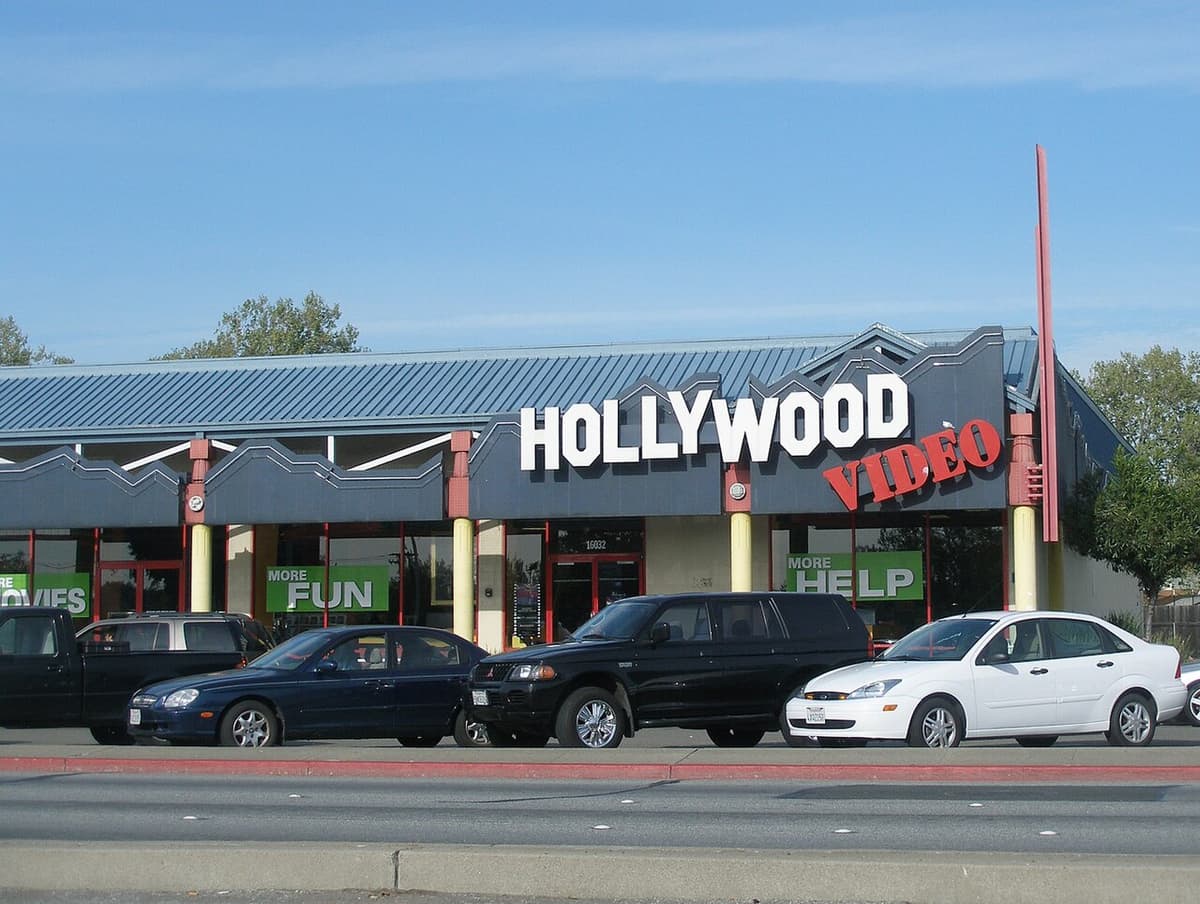
Hollywood Video storefront with white block letters and a red script word on a dark zigzag fascia, cars parked in front
A Hollywood Video in San Lorenzo, California, photographed in April 2007. Photo: Coolcaesar, via Wikimedia Commons, CC BY-SA 3.0.

1988 – 1996 · A superstore from Oregon

Twenty-five stores, then 551

Mark J. Wattles had run a two-store video rental business and a company that put rental centers in about 300 convenience stores before he founded Hollywood Entertainment in June 1988.1 The company was incorporated in Oregon on June 2, 1988 and opened its first Hollywood Video store that October.15

It went public in July 1993 and ended that year with 25 stores and revenue of $17.3M.1 Then it bought and built. In 1994 it opened 33 stores and acquired 55. In 1995 it opened 122 and acquired 70, among them 42 Video Watch superstores bought that August for about $60.3M. In 1996 it opened 250 stores and acquired none.1

By the end of 1996 there were 551 stores in 29 states and revenue was $302.3M. The company said it planned to open at least 300 more in 1997.1

Chapter 2 of 5

$548.3M

net loss in 2000, as restated in the 2004 annual report

Commercial · 2000Hollywood Video commercial: five-day rentals A spot promoting a new release for five days. The 2000 date is the uploader’s. That was the year the company closed Reel.com’s store and reported its largest loss.3 Watch on YouTube

1997 – 2000 · Reel.com and the crisis

A web store it could not fund

The building continued: 907 stores at the end of 1997, 1,260 a year later, 1,615 at the end of 1999. Long-term obligations rose from $82.4M in 1996 to $533.9M in 1999.2

On October 1, 1998 Hollywood bought Reel.com, an online seller of videocassettes and DVDs, for about $96.9M. Wattles left his full-time post at Hollywood to run it.34 The same quarter the company signed revenue-sharing agreements with the studios, which put many more copies of new releases on the shelves, and began renting DVDs in most stores.3 It reported net losses of $50.5M in 1998 and $51.3M in 1999.2

Reel.com reached a run rate of about $80M in annual revenue and lost cash at a rate the company put at about $60M a year. A registration statement for a Reel.com public offering was filed in December 1999. No outside money arrived. On June 12, 2000 Hollywood closed Reel.com’s e-commerce business, and the next day dismissed about 200 of its 240 employees. The charge was $69.3M.3

In the fourth quarter of 2000 same-store sales fell for the first time in 21 quarters and the company wrote down $74.3M of stores and goodwill. It was in violation of its credit facility covenants at year end, and its auditors wrote that there was substantial doubt about its ability to continue as a going concern.3

Since we were unable to fund its continued losses, we closed down the money-losing e-commerce business on June 12, 2000.

Hollywood Entertainment, annual report for 20003

Chapter 3 of 5

$1.78B

revenue in 2004, the last year as an independent company

Original illustration of a game trade-in counter inside a rental store. Not an official asset.

2001 – 2004 · The recovery

Stop building, pay down, add games

Wattles returned full time in August 2000.4 The company said it had almost stopped opening stores, on which it had been spending at a rate of about $140M a year, and would use its cash to reduce debt.3 The store count barely moved for two years: 1,819 at the end of 2000, 1,801 at the end of 2001.5

The results turned. As restated in the 2004 annual report, Hollywood earned $102.5M in 2001, $259.7M in 2002, $80.1M in 2003 and $71.3M in 2004. Long-term obligations fell from $536.4M at the end of 2000 to $351.3M at the end of 2004.5

The new idea was Game Crazy, a department inside a Hollywood Video store where customers could buy, sell and trade video games. There were 67 at the end of 1999 and 695 in-store departments, plus 20 free-standing stores, at the end of 2004, when Game Crazy brought in about 16% of revenue.25

The annual report for 2004 named the pressures on rental: cheap DVDs for sale, subscription services and video on demand. It also said the studios’ exclusive window for home video reduced the threat.5

Chapter 4 of 5

$13.25

a share in cash, the Movie Gallery price the board accepted

Original illustration of a rental DVD case, a disc and a tape. Rental product was about 78% of Hollywood’s 2004 revenue.5

Mar 2004 – Apr 2005 · Three bidders

$14.00, $10.25, $11.50, $13.25, $14.50

On March 28, 2004 Hollywood agreed to be taken private by an affiliate of Leonard Green & Partners at $14.00 a share in cash.6 On October 13 the agreement was amended: the price fell to $10.25, the termination fee was removed and Hollywood was allowed to solicit other offers.78

Two arrived. Blockbuster, the industry leader, wrote on November 2 that it was prepared to offer $11.50 a share in cash. Movie Gallery, a chain of mostly rural stores based in Dothan, Alabama, offered $11.00 on November 10.8 On January 9, 2005 Hollywood ended the Leonard Green agreement, paying $4.0M of the buyer’s expenses, and signed with Movie Gallery at $13.25 in cash.5

Blockbuster went hostile. On February 2, 2005 it said it would offer $11.50 in cash plus $3.00 of its own stock, $14.50 in all. Wattles resigned as chairman and chief executive the same day.8 The board told shareholders not to tender, citing the antitrust uncertainty.58 On March 25 Blockbuster let the offer expire, after what the Associated Press called resistance from federal antitrust regulators.9

Movie Gallery completed the merger on April 27, 2005. It valued the deal at about $1.25 billion including Hollywood’s debt.10

This is what we had said all along, that we thought (Blockbuster’s bid) was going to run into problems.

Larry Denedy, Hollywood spokesman, Associated Press, Mar 25, 20059

Chapter 5 of 5

545

Hollywood Video stores left after the February 2010 closures

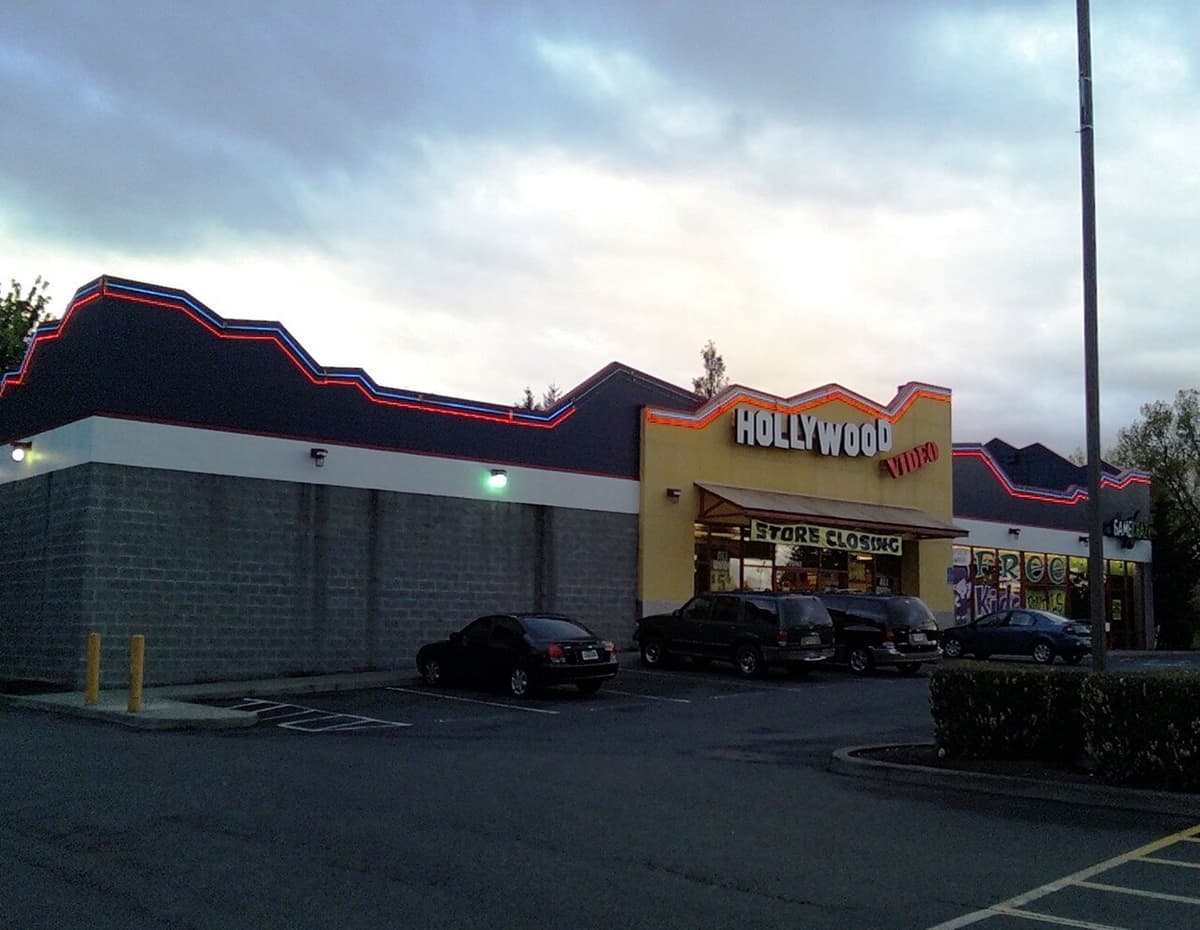
Hollywood Video store at dusk with red and blue neon along the roofline and a Store Closing banner over the entrance
A Hollywood Video in Aloha, Oregon, with a Store Closing banner, May 2010. Photo: M.O. Stevens, via Wikimedia Commons, CC BY-SA 3.0.

Apr 2005 – 2010 · Movie Gallery

Borrowed money, two bankruptcies, liquidation

Movie Gallery paid $862.1M for Hollywood’s shares and $384.7M to refinance its debt. It financed the purchase with about $180.0M of Hollywood’s own cash, an $870.0M senior secured credit facility and $325.0M of 11% notes.11 At January 1, 2006 it owed about $1,161.2M.11

The first year ended with a $522.95M goodwill impairment, $361.2M of it in the Hollywood Video segment, and a net loss of $552.7M.11 Hollywood’s same-store revenue fell 5.4% in 2006.12 In 2007 Movie Gallery cut the value of the Hollywood trademark twice, by $95.4M and then $60.5M, to $15.0M.13 Many vendors, including many movie studios, stopped extending trade credit and asked for cash in advance.13

Movie Gallery filed for Chapter 11 in Richmond, Virginia on October 16, 2007 and emerged on May 20, 2008. The old shares were cancelled for no consideration.1314 The number of Hollywood Video stores fell from 2,045 at the end of 2006 to 1,646 in January 2008.1213

It filed again on February 2, 2010 and began closing about 760 stores at once, leaving 545 Hollywood Video stores among 1,906.1517 In early May it told the court it would close everything. A judge approved the plan on May 19.1920 The date the last Hollywood Video store closed is not in our sources.

We do not see a cost-benefit advantage in the adoption of a first-mover strategy that ignores underlying economic fundamentals.

Movie Gallery, annual report for fiscal 2007, on why it would not invest in kiosks or online rental13

Timeline

Twenty-two years, 34 moments

From one store in Oregon to a blog. Filter by thread.

All 34 events as a list
  1. Jun 21988
    Corporate

    Hollywood Entertainment incorporated

    Mark J. Wattles founds the company in Oregon.1

  2. Oct1988
    Stores & product

    First Hollywood Video store opens

    The first store opens four months after incorporation.15

  3. Jul1993
    Money

    Initial public offering

    The company goes public. It ends the year with 25 stores and revenue of $17.3M.1

  4. 1994
    Stores & product

    113 stores

    Hollywood opens 33 stores and acquires 55 in one year.1

  5. Aug1995
    Money

    Video Watch bought

    The assets of 42 Video Watch superstores are acquired for about $60.3M. The year ends with 305 stores in 23 states.1

  6. 1996
    Stores & product

    250 openings in a year

    The chain reaches 551 stores in 29 states and plans at least 300 more for 1997.1

  7. 1997
    Stores & product

    907 stores

    Revenue passes $500M. Long-term obligations reach $233.5M.2

  8. Oct 11998
    Money

    Reel.com acquired

    Hollywood buys the online video retailer for about $96.9M. Wattles leaves his full-time post to run it.34

  9. Q41998
    Stores & product

    Revenue sharing and DVD

    Revenue-sharing agreements with studios begin, and DVDs go on rental in most stores.3

  10. 1998
    Money

    First annual loss

    A net loss of $50.5M on revenue of $763.9M.2

  11. 1999
    Stores & product

    Game Crazy

    67 game departments are open inside Hollywood Video stores by year end. The chain has 1,615 stores.2

  12. Dec1999
    Money

    Reel.com files to go public

    A registration statement for a Reel.com offering is filed. The offering does not happen.3

  13. Jan 242000
    Money

    Rentrak settlement

    Hollywood pays Rentrak about $14.0M and issues 200,000 shares to settle a suit over revenue sharing.3

  14. Jun 122000
    Bankruptcy & end

    Reel.com’s store closed

    The e-commerce business is shut down. About 200 of 240 employees are dismissed the next day. The charge is $69.3M.3

  15. Aug2000
    Corporate

    Wattles returns

    The founder returns full time to Hollywood.4

  16. Q42000
    Money

    Stores written down

    Same-store sales fall for the first time in 21 quarters. An impairment charge of $74.3M follows.3

  17. Dec 312000
    Bankruptcy & end

    Going-concern warning

    The company is in violation of its credit covenants. Its auditors cite substantial doubt about its ability to continue.3

  18. Jan 252001
    Corporate

    A new contract for the founder

    Wattles receives 3 million shares, worth $3.27M that day, under a new employment agreement.3

  19. 2002
    Money

    Recovery

    Net income of $259.7M, as restated, and long-term obligations down to $388.7M.5

  20. Mar 282004
    Takeover

    Leonard Green buyout at $14.00

    Hollywood agrees to be taken private by an affiliate of Leonard Green & Partners.6

  21. Oct 132004
    Takeover

    Price cut to $10.25

    The merger agreement is amended and Hollywood is allowed to seek other bids.78

  22. Nov 22004
    Takeover

    Blockbuster proposes $11.50

    Blockbuster writes that it is prepared to make an all-cash offer.8

  23. Nov 102004
    Takeover

    Movie Gallery proposes $11.00

    A written proposal arrives from the Alabama chain.8

  24. Jan 92005
    Takeover

    Movie Gallery signs at $13.25

    Hollywood ends the Leonard Green agreement, paying $4.0M of expenses, and signs with Movie Gallery.5

  25. Feb 22005
    Takeover

    Blockbuster raises to $14.50; Wattles resigns

    Blockbuster offers $11.50 in cash and $3.00 in stock. Wattles resigns as chairman and CEO.8

  26. Mar 252005
    Takeover

    Blockbuster withdraws

    Blockbuster lets its hostile offer expire amid antitrust resistance.9

  27. Apr 272005
    Corporate

    Merger completed

    Hollywood becomes a subsidiary of Movie Gallery in a deal valued at about $1.25B including debt.10

  28. FY2005
    Money

    $522.95M goodwill impairment

    Movie Gallery reports a net loss of $552.7M for its first year with Hollywood.11

  29. 2007
    Money

    Trademark written down

    The Hollywood trademark is impaired by $95.4M and $60.5M, to $15.0M.13

  30. Oct 162007
    Bankruptcy & end

    Movie Gallery’s first Chapter 11

    The company and its U.S. subsidiaries file in Richmond, Virginia.1314

  31. May 202008
    Corporate

    Emergence

    Movie Gallery leaves bankruptcy. Old shares are cancelled. By late 2008 affiliates of Sopris Capital control 86.3% of the votes.13

  32. Feb 22010
    Bankruptcy & end

    Second Chapter 11

    About 760 stores begin closing at once. 545 Hollywood Video stores remain.151617

  33. May2010
    Bankruptcy & end

    Liquidation

    Movie Gallery tells the court it will close its remaining stores. A judge approves on May 19.181920

  34. Oct2010
    Corporate

    Brands sent to auction

    The estate submits a plan to auction its intellectual property, including Reel.com, through StreamBank.21

Hollywood Video storefront with white block letters and a red script word on a dark zigzag fascia
Apr 2007 A Hollywood Video in San Lorenzo, California, two years into Movie Gallery’s ownership.Photo: Coolcaesar at English Wikipedia, via Wikimedia Commons, CC BY-SA 3.0. The logo remains a trademark of its owner.

Part 2 of 6

Business

The numbers · Rivals

The money

Sixteen years of filings

Hollywood Entertainment filed annual reports for every year from 1996 to 2004, and Movie Gallery reported Hollywood Video as a segment for three more. After January 2008 Movie Gallery stopped filing, and the record is press reports.

Stores: built in six years, emptied in three

Company-operated Hollywood Video stores at each date. Year ends to 2004; Movie Gallery’s fiscal year ends after that.

01,0002,0003,0001992199419961998200020022004Dec ’06Feb ’1012345601,0002,0003,0001992199620002004Feb ’10123456
  1. 1993 · the IPO 25 stores at the end of 1993, the year the company went public.1
  2. 1999 · the binge 1,615 stores at the end of 1999, and $533.9M of long-term obligations.2
  3. 2001 · the pause 1,801 stores at the end of 2001, after the company almost stopped building.35
  4. 2004 · the sale 2,006 stores at the end of 2004. Movie Gallery signs nine days later.5
  5. Jan ’08 · the first bankruptcy 1,646 stores in January 2008, with Movie Gallery in Chapter 11.13
  6. Feb ’10 · the second 545 stores left after the February 2010 closures.17
Data table
Stores: built in six years, emptied in three
Year end, then dates of later reports (not evenly spaced)Hollywood Video stores
199215
199325
1994113
1995305
1996551
1997907
19981,260
19991,615
20001,819
20011,801
20021,831
20031,920
20042,006
Jan ’062,054
Dec ’062,045
Jan ’081,646
Feb ’10545
1992–19961; 1997–19992; 2000–20045; January 1, 200611; December 31, 200612; January 6, 200813; February 2010, after announced closures17. We found no count for the end of 2008 or 2009.

Revenue, 1992 to 2004

Hollywood Entertainment, $ millions. Includes Reel.com from October 1998 to mid-2000 and Game Crazy.

Data table
Revenue, 1992 to 2004
PeriodRevenue ($M)
1992$11M
1993$17.3M
1994$73.3M
1995$149.4M
1996$302.3M
1997$500.5M
1998$763.9M
1999$1096.8M
2000$1296.2M
2001$1379.5M
2002$1490.1M
2003$1682.5M
2004$1782.4M
1992–19941; 1995–19992; 2000–2004, as restated5.

Net income and loss, 1995 to 2004

$ millions. One year accounts for more than all the profits before it.

Data table
Net income and loss, 1995 to 2004
PeriodNet income or loss ($M)
1995$9.2M
1996$20.6M
1997$5M
1998$-50.5M
1999$-51.3M
2000$-548.3M
2001$102.5M
2002$259.7M
2003$80.1M
2004$71.3M
1995–1999 as reported in the 1999 annual report2. 2000–2004 as restated in the 2004 annual report for lease accounting5; the figures first reported were a loss of $530.0M for 2000 and profits of $100.4M, $241.8M and $82.3M for 2001–2003.5

Long-term obligations, 1995 to 2004

$ millions at year end, including the current portion.

Data table
Long-term obligations, 1995 to 2004
PeriodLong-term obligations ($M)
1995$8M
1996$82.4M
1997$233.5M
1998$392.1M
1999$533.9M
2000$536.4M
2001$514M
2002$388.7M
2003$371.3M
2004$351.3M
1995–19992; 2000–20045. The 2004 report’s definition of long-term obligations may differ slightly from the 1999 report’s.

The year 2000

$69.3M
charge for closing Reel.com’s e-commerce business in June3
$74.3M
impairment of stores and goodwill in the fourth quarter3
$112.5M
of bank debt reclassified as current because covenant waivers ran only to May 5, 20013
$222.4M
shareholders’ deficit at December 31, 2000, as first reported3
Hollywood Entertainment, annual report for 2000.3

What each bidder offered

Dollars per Hollywood share, in the order the offers were made.

Leonard Green, Mar 2004
$14.00
Cash; signed6
Leonard Green, Oct 2004
$10.25
Cash; amended7
Blockbuster, Nov 2004
$11.50
Cash; proposal8
Movie Gallery, Nov 2004
$11.00
Cash; proposal8
Movie Gallery, Jan 2005
$13.25
Cash; accepted5
Blockbuster, Feb 2005
$14.50
$11.50 cash + $3.00 stock; withdrawn89
Data table
What each bidder offered
OfferPer shareNote
Leonard Green, Mar 2004$14.00Cash; signed
Leonard Green, Oct 2004$10.25Cash; amended
Blockbuster, Nov 2004$11.50Cash; proposal
Movie Gallery, Nov 2004$11.00Cash; proposal
Movie Gallery, Jan 2005$13.25Cash; accepted
Blockbuster, Feb 2005$14.50$11.50 cash + $3.00 stock; withdrawn
Hollywood Entertainment filings5678 and the Associated Press.9

What Movie Gallery paid out to buy Hollywood

Cash paid at the April 2005 acquisition, $ millions.

$1246.8M Paid in the acquisition (derived)
$862.1M 69%To Hollywood shareholders$384.7M 31%To refinance Hollywood’s debt$862.1M 69%To Hollywood shareholders$384.7M 31%To refinance Hollywood’s debt
  • To Hollywood shareholders. $13.25 a share11
  • To refinance Hollywood’s debt. Including its 9.625% notes11
Data table
What Movie Gallery paid out to buy Hollywood
Where it wentAmountShareNote
To Hollywood shareholders$862.1M69%$13.25 a share
To refinance Hollywood’s debt$384.7M31%Including its 9.625% notes
Movie Gallery, annual report for fiscal 2005.11 The total is derived: $862.1M + $384.7M. It was financed with about $180.0M of Hollywood’s cash, an $870.0M credit facility and $325.0M of 11% notes; the facility also replaced Movie Gallery’s own revolving credit line.11

The Hollywood trademark on Movie Gallery’s books

Carrying value at the end of 2006 and what became of it in 2007, $ millions.

$171.0M Carrying value, Dec 31, 2006
$95.4M 56%Written off, second quarter 2007$60.5M 35%Written off, third quarter 2007$15.0M 9%Left on the books$95.4M 56%Written off, second quarter 2007$60.5M 35%Written off, third quarter 2007$15.0M 9%Left on the books
  • Written off, second quarter 2007. Fair value put at $75.5M13
  • Written off, third quarter 2007. After the royalty-rate assumption was cut13
  • Left on the books. To be amortized over 10 years13
Data table
The Hollywood trademark on Movie Gallery’s books
Where it wentAmountShareNote
Written off, second quarter 2007$95.4M56%Fair value put at $75.5M
Written off, third quarter 2007$60.5M35%After the royalty-rate assumption was cut
Left on the books$15.0M9%To be amortized over 10 years
Movie Gallery, annual report for fiscal 2007.13 The opening value is $170.977M in the filing; the parts sum to $170.9M because the filing rounds each to one decimal.

Hollywood Video inside Movie Gallery

The Hollywood Video segment, $ millions. Game Crazy was reported separately.

Fiscal yearRental revenueProduct salesSegment revenue (derived)Operating income (loss)Stores at year end
2005 (from Apr 27)857.675.5933.1(303.3)2,054
20061,236.5109.31,345.7116.82,045
2007 (53 weeks)1,077.8116.91,194.7(516.2)1,646
Movie Gallery annual reports for fiscal 200511, 200612 and 200713. Segment revenue is derived: rental revenue plus product sales. The 2005 loss includes $361.2M of goodwill impairment; the 2007 loss includes $115.4M of goodwill and $158.4M of other intangible impairments.

Eighty times the chain that went public

2,006stores at the end of 20045
=
80 ×stores at the end of 1993, the IPO year1 (25; each icon is the whole 1993 chain (25 stores))

Derived 2,006 ÷ 25 ≈ 80.2. Store counts from the 1996 and 2004 annual reports.15

Data table
Eighty times the chain that went public
Value
stores at the end of 20042,006
stores at the end of 1993, the IPO year25
Ratio80 (derived)

The rivals

The leader next door, and the ones without stores

Nearly every Hollywood Video had a Blockbuster close by. The competitors that mattered in the end had no stores at all.

Who won, who died

The rental chains of 2004 and the service that replaced them.

Hollywood Video

Ghost
1993: 252010
2,006 stores (2004) Sold to Movie Gallery in 2005 and liquidated in 2010. The name survives on a blog.51922

Blockbuster

Chapter 11, Sep 2010
5,803 U.S. stores (2004) The leader, with 9,094 stores worldwide. Bid for Hollywood and withdrew. Filed for Chapter 11 on September 23, 2010.92324

Movie Gallery

Dead
Jan 2005Feb 2010
2,482 stores (Jan 2005) The buyer. 4,749 stores after the merger, Chapter 11 in 2007 and 2010, then liquidation.111319

Netflix

Survived
20022006
6.3M subscribers (2006) Rental by mail, with no stores. Subscribers went from 857,000 at the end of 2002 to 6.3 million at the end of 2006.25
Data table
Who won, who died
CompanyOutcomeStores or subscribersNotesSeries
Hollywood VideoGhost2,006 stores (2004)Sold to Movie Gallery in 2005 and liquidated in 2010. The name survives on a blog.25, 305, 907, 1615, 1819, 2006, 2054, 1646, 545, 0
BlockbusterChapter 11, Sep 20105,803 U.S. stores (2004)The leader, with 9,094 stores worldwide. Bid for Hollywood and withdrew. Filed for Chapter 11 on September 23, 2010.
Movie GalleryDead2,482 stores (Jan 2005)The buyer. 4,749 stores after the merger, Chapter 11 in 2007 and 2010, then liquidation.2482, 4749, 4642, 3889, 1906
NetflixSurvived6.3M subscribers (2006)Rental by mail, with no stores. Subscribers went from 857,000 at the end of 2002 to 6.3 million at the end of 2006.857, 1487, 2610, 4179, 6316
Store counts from the companies’ annual reports5111323; Movie Gallery’s February 2010 figure is from Bloomberg News15. Netflix subscribers in thousands.25 The series are not on a common scale.

Stores at the end of 2004

The three chains in the takeover fight, just before it was settled.

Blockbuster (U.S., incl. franchised)
5,803
Dec 31, 200423
Movie Gallery
2,482
Jan 2, 2005; all stores11
Hollywood Video
2,006
Dec 31, 2004; company-operated5
Data table
Stores at the end of 2004
ChainStoresNote
Blockbuster (U.S., incl. franchised)5,803Dec 31, 2004
Movie Gallery2,482Jan 2, 2005; all stores
Hollywood Video2,006Dec 31, 2004; company-operated
Blockbuster23, Movie Gallery11 and Hollywood Entertainment5 annual reports. The bases differ slightly, as noted on each bar.
No. 2, urban and suburban superstores

Hollywood Video

U.S. stores, end of 2004
2,0065
Typical store
About 6,600 sq ft5
Games
695 in-store Game Crazy departments5
Rental by mail
None in our sources
End
Liquidated by its owner, 201019
The category leader

Blockbuster

U.S. stores, end of 2004
5,80323
Worldwide stores, end of 2004
9,09423
Bid for Hollywood
$14.50 a share, withdrawn9
Rental by mail
Blockbuster Online13
End
Chapter 11, Sep 23, 201024
Hollywood Entertainment5, Blockbuster2324 and Movie Gallery13 filings; the Associated Press.9

Substantially all of our stores compete with stores operated by Blockbuster, most in very close proximity.

Hollywood Entertainment, annual report for 20045

The Associated Press reported in 2005 that regulators had blocked a Blockbuster–Hollywood combination once before, in 1999.9 We did not find a primary record of that earlier episode and give it only on the AP’s authority.

Part 3 of 6

Brand

Commercials & footage · Brand gallery

Commercials & footage

Coming attractions, and the closing sale

Two commercials from the years of fastest growth, local news and an investment manager’s commentary from the 2010 bankruptcy, and a staff training tape. Where the year comes only from the uploader, the caption says so.

Commercial · 1998Hollywood Video commercial with a movie-trailer voiceover A 30-second spot in the style of a film trailer. The uploader dates it to 1998 and credits the voice to Don LaFontaine; we could not confirm either. The upload is a 2021 remaster. The chain had 1,260 stores at the end of 1998.2 Watch on YouTube
Commercial · 2000Hollywood Video commercial: five-day rentals A spot promoting a new release for five days. The 2000 date is the uploader’s. That was the year the company closed Reel.com’s store and reported its largest loss.3 Watch on YouTube
News segment · 2010KRQE: “Hollywood Video shuts most ABQ stores” A short report from KRQE, the Albuquerque station, published on its own channel on February 5, 2010, days after Movie Gallery’s second Chapter 11 filing.15 Watch on YouTube
Interview · 2010An investment manager on the Hollywood Video bankruptcy Shawn Narancich of the investment firm Ferguson Wellman discusses the bankruptcy. Published on the firm’s channel on March 8, 2010. It is commentary, not a source for any figure on this page. Watch on YouTube
Film · 2009Hollywood Video staff training video A 22-minute training tape on greeting and selling to customers. The 2009 date is the uploader’s; the upload is from 2016. Watch on YouTube

Videos are embedded from the services that host them and load only when you press play. YouTube embeds use youtube-nocookie.com. Each video belongs to its uploader or rights holder and is shown here for commentary; we do not host any of the files. Upload dates were read from the YouTube pages in October 2026. We could not reach the Internet Archive from our research environment, so no archived footage is included.

Part 4 of 6

People

People · Press

The people

Who built it, who bid for it, who bought it

Titles and ages are as given in the filings and press of the time. Later careers are left out where we have no source.

People (5)
Name and roleWhat they didAfterwards
Mark J. WattlesFounder; chairman and CEO, 1988 – 2005

Ran a two-store rental business and a convenience-store video distributor before founding Hollywood in June 1988. Left his full-time post from August 1998 to June 2000 to run Reel.com, returned that August, and resigned on February 2, 2005, three weeks after the Movie Gallery agreement.148

His company Boards, Inc. operated 20 Hollywood Video stores as a licensee, paying $25,000 a store and a 2% royalty.58
F. Bruce GiesbrechtPresident and COO, 2004; CEO from Feb 2005

Joined Hollywood in May 1993 and became president and chief operating officer in January 2004. The board named him chief executive when Wattles resigned. He was 45.5

Timothy R. PriceChief financial officer, 2003 – 2005

Joined in January 2003 as senior vice president of finance and became chief financial officer that July. He joined Movie Gallery with the merger and became chief financial officer of the combined company in July 2005.511

Joe T. MalugenChairman and CEO, Movie Gallery

Co-founded Movie Gallery in 1985 and was chairman, president and chief executive when it bought Hollywood. He was 54 in early 2006.11

John AntiocoCEO, Blockbuster

Led the hostile bid for Hollywood and announced its end on March 25, 2005.9

The clippings

What they said at the time

Press (5)
Our decision not to extend our offers was reached after a careful review of all of the available facts and circumstances.
John Antioco, Blockbuster chief executive, Associated Press, Mar 25, 20059
For the near term, we do not intend to make additional significant investments in either a movie kiosk program or the integration of an online video rental channel.
Movie Gallery, annual report for fiscal 2007, filed Dec 200813
  1. Hollywood Entertainment, annual report for 20003

    After being a net user of cash since our inception as a result of rapid store growth, we became a net generator of cash in the fourth quarter of 2000.
  2. Larry Denedy, Hollywood spokesman, Associated Press, Mar 25, 20059

    This is what we had said all along, that we thought (Blockbuster’s bid) was going to run into problems.
  3. hollywoodvideo.com, “About The New Hollywood Video”, read Oct 202622

    Hollywood Video may no longer be the neighborhood rental store, but the mission is still the same: help people find something worth watching.
Hollywood Video store at dusk with neon along the roofline and a Store Closing banner
May 2010 A Hollywood Video in Aloha, Oregon, during its closing sale. A Game Crazy sign is at the right.Photo: M.O. Stevens, via Wikimedia Commons, CC BY-SA 3.0. The logo remains a trademark of its owner.

Part 5 of 6

Verdict

Cause of death · What if · Afterlife

Cause of death

The autopsy

Tap a cause to see the evidence. The percentages are our editorial weighting. The evidence under each one is sourced.

Cause of death, by editorial weight

One square is one percentage point. The weights are our judgment, not a measurement.

  1. 35%The debt from the 2005 sale
  2. 30%Mail, kiosks and the internet
  3. 15%A shrinking rental business
  4. 10%Overexpansion and Reel.com, 1996 to 2000
  5. 10%A merger that was never finished
Data table
Cause of death, by editorial weight
CauseWeight
The debt from the 2005 sale35%
Mail, kiosks and the internet30%
A shrinking rental business15%
Overexpansion and Reel.com, 1996 to 200010%
A merger that was never finished10%

Movie Gallery paid $862.1M for the shares and $384.7M to refinance Hollywood’s debt, using an $870.0M credit facility and $325.0M of 11% notes, and owed about $1,161.2M eight months later. The Associated Press wrote in 2010 that it had been “unable to sustain the debt it took on.”1119

Movie Gallery blamed revenue declines on mail subscription services such as Netflix and Blockbuster Online and on kiosks such as Redbox. Netflix grew from 2.6 million subscribers at the end of 2004 to 6.3 million two years later. In 2008 Movie Gallery said it would not invest further in kiosks or online rental.1325

Hollywood’s 2004 annual report already described a trend of consumers buying cheap DVDs instead of renting. Hollywood Video’s same-store revenue fell 5.4% in 2006, and segment rental revenue fell from $1,236.5M in 2006 to $1,077.8M in 2007.51213

The chain tripled from 551 stores to 1,615 in three years on borrowed money, lost $50.5M and $51.3M in 1998 and 1999, and then took a $69.3M charge on Reel.com and a going-concern warning. It recovered, and in March 2004 it agreed to a buyout.236

Movie Gallery said its liquidity problems and Chapter 11 filing in 2007 kept it from integrating most business functions of the two chains. When results fell, many vendors, including many studios, stopped giving trade credit and required cash in advance.13

Editorial judgment: the weights are an interpretive model by the Spectre Brands editors, not a measured quantity. The filings and wire reports document the symptoms. How much each one contributed is a matter of opinion.

The fork in the road

What if…

Four decisions where the story could have gone differently. The “What if” panels are speculation, labeled as such.

What happened

Hollywood paid about $96.9M for Reel.com in October 1998, funded losses it put at about $60M a year, failed to find outside money and closed the store in June 2000 with a $69.3M charge.3

What if speculative

Without Reel.com the losses of 1998–2000 would have been smaller and the going-concern warning might not have been written. The $74.3M store impairment and the debt taken on to add 1,064 stores in three years (derived: 1,615 − 551) would still have been there, so a hard year in 2000 was likely either way.123

What happened

The Leonard Green buyout was signed at $14.00 a share in March 2004 and amended to $10.25 in October. Hollywood ended it in January 2005.567

What if speculative

A leveraged buyout would also have loaded the company with debt, so it is hard to see a different ending. It would have left Hollywood Video on its own, without the cost of combining two chains that Movie Gallery later said it never finished combining.13

What happened

Blockbuster offered $14.50 a share in cash and stock. The board recommended against it because of antitrust uncertainty, and Blockbuster withdrew on March 25, 2005.89

What if speculative

Had regulators allowed it, shareholders would have received $1.25 a share more (derived: $14.50 − $13.25), part of it in Blockbuster stock. The stores would then have belonged to a company that itself filed for Chapter 11 in September 2010.24

What happened

Movie Gallery financed the purchase with an $870.0M credit facility, $325.0M of 11% notes and about $180.0M of Hollywood’s own cash.11

What if speculative

With less borrowing, Movie Gallery might have had room to try kiosks or rental by mail, which it said in 2008 it would not fund.13 The rental business was shrinking in any case, and the industry leader, Blockbuster, also filed for Chapter 11 that year.24

Where are they now

The afterlife

Hollywood Video

  1. The name

    Reused

    hollywoodvideo.com is live. In October 2026 it described itself as “The NEW Hollywood Video”, an entertainment news site with a blog, and carried a “©2026 Hollywood Video” notice.22 The page does not say who operates it, and we could not establish who owns the trademark.

  2. The brands and domains

    Auctioned

    In October 2010 Movie Gallery’s estate submitted a plan to auction its intellectual property through StreamBank, including the Reel.com domain and trademark.21 Who bought the Hollywood Video name, and for how much, is not in our sources.

  3. The stores

    Liquidated

    A bankruptcy judge approved the closing of Movie Gallery’s remaining stores on May 19, 2010, and going-out-of-business sales followed.20 The Associated Press put the number at more than 1,900.19 The date the last Hollywood Video closed is not in our sources.

  4. Movie Gallery

    Buried

    The buyer went through Chapter 11 twice. Its shareholders received nothing in the first reorganization, and the company did not try to reorganize in the second.1318

  5. Game Crazy

    Closed

    The game departments went with the stores. Movie Gallery still counted 250 Game Crazy locations after the February 2010 closures; all were covered by the liquidation.1719

  6. Reel.com

    Shell

    After June 2000 Hollywood kept Reel.com as a content-only site funded by advertising.3 Ten years later it was one of the assets listed for auction, described by the seller as a possible competitor to movie review sites.21

  7. The rival

    Outlasted, briefly

    Blockbuster, whose bid Hollywood’s board turned away in 2005, filed for Chapter 11 on September 23, 2010, four months after Movie Gallery’s liquidation was approved.2024

Who owned the name

One founder, one buyer, two bankruptcies and an auction whose result we could not trace.

  1. Jun 1988

    Hollywood Entertainment Corp.

    Founded in Oregon by Mark J. Wattles. First store opens in October.1

  2. Jul 1993

    Hollywood Entertainment, public company

    Initial public offering. 25 stores at year end.1

  3. Apr 2005

    Movie Gallery, Inc.

    Acquires Hollywood at $13.25 a share.10

    about $1.25B incl. debt
  4. Oct 2007

    Movie Gallery, in Chapter 11

    First bankruptcy. The trademark has been written down to $15.0M.1314

  5. May 2008

    Movie Gallery, reorganized

    Emerges with its old shares cancelled. By late 2008 affiliates of Sopris Capital control 86.3% of the votes.13

  6. Feb 2010

    Movie Gallery, in Chapter 11

    Second bankruptcy, then liquidation of all stores.1519

  7. Oct 2010

    Movie Gallery estate

    Intellectual property sent to auction through StreamBank. The buyer is not in our sources.21

  8. Today

    Operator of hollywoodvideo.com

    An entertainment blog uses the name. Its owner is not identified on the site.22

Data table
Who owned the name
WhenOwnerWhat happenedPrice
Jun 1988Hollywood Entertainment Corp.Founded in Oregon by Mark J. Wattles. First store opens in October.
Jul 1993Hollywood Entertainment, public companyInitial public offering. 25 stores at year end.
Apr 2005Movie Gallery, Inc.Acquires Hollywood at $13.25 a share.about $1.25B incl. debt
Oct 2007Movie Gallery, in Chapter 11First bankruptcy. The trademark has been written down to $15.0M.
May 2008Movie Gallery, reorganizedEmerges with its old shares cancelled. By late 2008 affiliates of Sopris Capital control 86.3% of the votes.
Feb 2010Movie Gallery, in Chapter 11Second bankruptcy, then liquidation of all stores.
Oct 2010Movie Gallery estateIntellectual property sent to auction through StreamBank. The buyer is not in our sources.
TodayOperator of hollywoodvideo.comAn entertainment blog uses the name. Its owner is not identified on the site.
Hollywood Entertainment and Movie Gallery filings1101314, Bloomberg News15, the Associated Press19, Domain Name Wire21 and hollywoodvideo.com.22

Sources & data notes

Show your work

Primary sources first. SEC filings link to the original text on EDGAR (Hollywood Entertainment Corp., CIK 905895; Movie Gallery, Inc., CIK 925178). Movie Gallery stopped filing after its report for the year to January 6, 2008, so the end of the story rests on wire and local press.

  1. Hollywood Entertainment Corp. — Form 10-K, FY1996, filed Mar 31, 1997.
  2. Hollywood Entertainment Corp. — Form 10-K, FY1999, filed Mar 30, 2000.
  3. Hollywood Entertainment Corp. — Form 10-K, FY2000, filed Apr 2, 2001.
  4. Hollywood Entertainment Corp. — Form 10-K, FY2001, filed Apr 1, 2002.
  5. Hollywood Entertainment Corp. — Form 10-K, FY2004, filed Mar 17, 2005.
  6. Hollywood Entertainment Corp. — Form 8-K, merger agreement with affiliates of Leonard Green & Partners, filed Mar 29, 2004.
  7. Hollywood Entertainment Corp. — Form 8-K, amended and restated merger agreement, filed Oct 14, 2004.
  8. Hollywood Entertainment Corp. — Schedule 14D-9, response to Blockbuster’s exchange offer, filed Feb 17, 2005.
  9. Associated Press, on NBC News — “Blockbuster ends bid for rival”, Mar 25, 2005.
  10. Movie Gallery, Inc. — Form 8-K, completion of the acquisition of Hollywood, filed Apr 29, 2005.
  11. Movie Gallery, Inc. — Form 10-K, FY2005, filed Mar 24, 2006.
  12. Movie Gallery, Inc. — Form 10-K, FY2006, filed Mar 16, 2007.
  13. Movie Gallery, Inc. — Form 10-K, FY2007 (year ended Jan 6, 2008), filed Dec 18, 2008.
  14. Movie Gallery, Inc. — Form 8-K, Chapter 11 filing, filed Oct 17, 2007.
  15. Bloomberg News, in Indianapolis Business Journal — “Movie Gallery files second bankruptcy in two years”, Feb 4, 2010.
  16. Associated Press, on NBC News — “Hollywood Video owner files for bankruptcy”, Feb 3, 2010.
  17. KRWG Public Media — “Las Cruces Movie Gallery Closing”, Feb 4, 2010. Carries the company’s statement on the filing.
  18. ICv2 — “Movie Gallery R.I.P.”, May 3, 2010.
  19. Associated Press, in The Herald (Everett) — “No. 2 video rental company to close all remaining stores”, May 10, 2010.
  20. Nathan Bomey, AnnArbor.com — “Hollywood Video closing final Ann Arbor store as chain liquidates”, May 21, 2010.
  21. Andrew Allemann, Domain Name Wire — “Reel.com Bankruptcy Auction Plan Submitted to Court”, Oct 14, 2010.
  22. hollywoodvideo.com — “About The New Hollywood Video” and the home page, read Oct 8, 2026.
  23. Blockbuster Inc. — Form 10-K, FY2005, filed Mar 15, 2006.
  24. Blockbuster Inc. — Form 8-K, Chapter 11 filing, Sep 23, 2010.
  25. Netflix, Inc. — Form 10-K, FY2006, filed Feb 28, 2007.
Data notes (8)

Data notes

Derived: $1,246.8M paid in the acquisition is $862.1M + $384.7M.11 Hollywood Video segment revenue under Movie Gallery is rental revenue plus product sales: 857.6 + 75.5 = 933.1; 1,236.5 + 109.3 = 1,345.7; 1,077.8 + 116.9 = 1,194.7 ($M, each rounded from thousands).111213 2,006 ÷ 25 ≈ 80.2.15 $14.50 − $13.25 = $1.25 a share.8 The trademark flow uses $171.0M for a filed value of $170.977M; 95.4 + 60.5 + 15.0 = 170.9.13 “Tripled from 551 to 1,615” is 1,615 ÷ 551 ≈ 2.9, and 1,615 − 551 = 1,064 stores added between the end of 1996 and the end of 1999.12

Restated figures: Results for 2000–2003 are given as restated in the 2004 annual report for lease accounting (net loss of $548.3M for 2000). The figures first reported were a net loss of $530.0M for 2000 and a shareholders’ deficit of $222.4M; the 2000 counters use the first-reported deficit and say so.35 Figures for 1995–1999 are as reported in the 1999 annual report and were not restated.2

Mixed series: The store series on the card, in the arc chart and in the rivals block joins three sources: Hollywood’s year-end counts to 2004125, Movie Gallery’s segment counts for January 2006, December 2006 and January 2008111213, and the company’s February 2010 statement as carried by KRWG.17 The final zero stands for the 2010 liquidation and is not a reported count. Counts exclude the 20 licensed stores operated by Boards, Inc.5

Conflicts between sources: Movie Gallery valued the 2005 deal at about $1.25 billion including assumed debt10; the Associated Press described it in 2010 as an $850 million acquisition plus about $350 million of assumed debt, and in 2005 put Movie Gallery’s bid at about $900 million and Blockbuster’s at about $985 million for the shares and options.919 The February 2010 closures are 760 in the company statement and Bloomberg and 805 in the AP.151617 Press reports of Movie Gallery’s debt in 2010 range from $500 million–$1 billion to roughly $600 million; we give no figure.20 Wattles’s resignation is dated February 2, 2005 in the Schedule 14D-9 and was announced on February 3 according to the annual report.58

Unverified or unknown: The date the last Hollywood Video store closed: July 31, 2010 is widely repeated online, but we found no contemporary source and treat it as unverified. Who bought the Hollywood Video trademark and domain in the 2010 auction, what was paid, and who operates hollywoodvideo.com today. Hollywood Video store counts for the end of 2008 and 2009. Movie Gallery’s results after January 6, 2008, other than the 2009 revenue reported by Bloomberg.15 Why Leonard Green’s price fell from $14.00 to $10.25: the filings we read record the change, not a single stated reason.78 The 1999 antitrust episode mentioned by the AP.9

How we read the sources: All SEC filings were downloaded from EDGAR and read as text. Press articles were opened at the linked URLs in October 2026. Three trade-press pages on the liquidation and the brand auction (Chain Store Age, KGW, King 5) refused automated access and are not cited. The Internet Archive could not be reached during research, so there are no Wayback captures of hollywoodvideo.com on this page and the paragraph on the site today describes only what the live site showed on October 8, 2026.22

Images and video: The two photographs are from Wikimedia Commons under CC BY-SA 3.0, credited in the captions; their dates are those given on their Commons pages. Airing years of the two commercials and the training tape are the uploaders’. The KRQE and Ferguson Wellman videos carry their own channels’ 2010 publication dates.

General knowledge: That Netflix rented DVDs by mail and Redbox rented them from kiosks in this period, and that Blockbuster was the largest U.S. video rental chain.